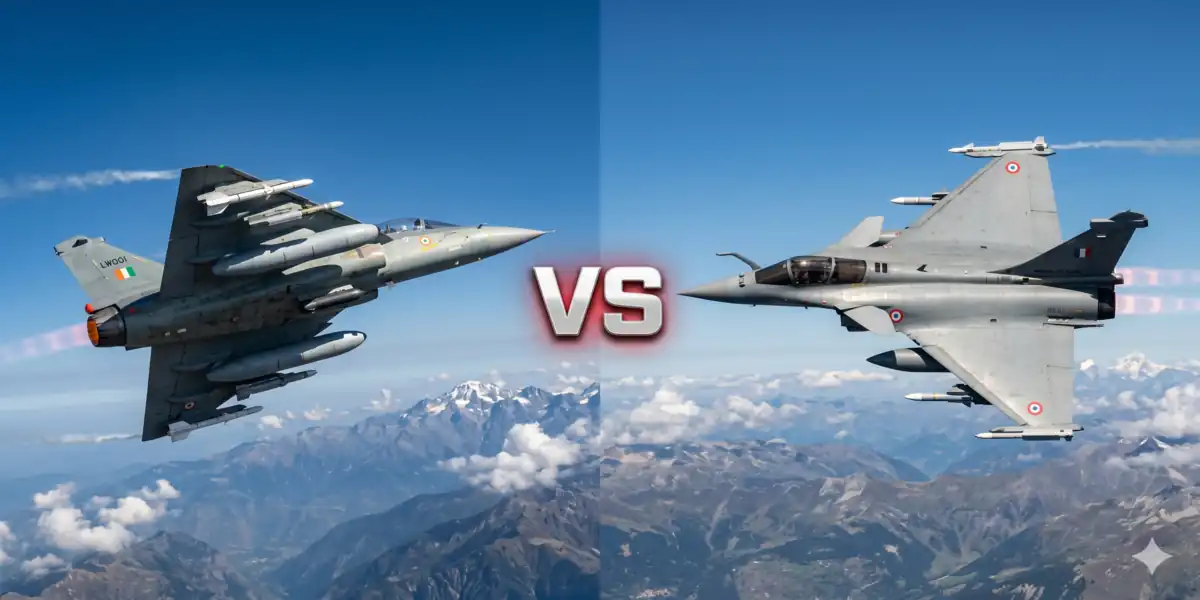
<h4 class="wp-block-heading">HAL Tejas Mk2 vs Rafale: The New Era of Air Supremacy</h4>
<p>As India moves toward a 42-squadron strength, the debate has shifted from “what can we buy?” to “what can we build?” The <strong>HAL Tejas Mk2 vs Rafale</strong> comparison is no longer about a lightweight jet vs a heavyweight; it’s about a modern, indigenous <strong>4.5 gen fighter jet</strong> challenging the global status quo.</p>
<h4 class="wp-block-heading">HAL Tejas Mk2 vs Rafale: The Technical Showdown</h4>
<p>The <strong><a href="https://en.wikipedia.org/wiki/Dassault_Rafale" data-type="link" data-id="https://en.wikipedia.org/wiki/Dassault_Rafale">Dassault Rafale</a></strong> is a combat-proven powerhouse, but the <strong>HAL Tejas Mk2</strong> (also known as the Medium Weight Fighter) is designed with a unique “Indian advantage.” While the Rafale excels in payload, the Tejas Mk2 offers a futuristic sensor suite that, in some areas, actually surpasses current French standards.</p>
<figure class="wp-block-table"><table class="has-fixed-layout"><tbody><tr><th class="has-text-align-left" data-align="left">Feature</th><th class="has-text-align-left" data-align="left"><strong>HAL Tejas Mk2</strong></th><th class="has-text-align-left" data-align="left"><strong>Dassault Rafale</strong></th></tr><tr><td><strong>Engine</strong></td><td><strong>GE F414-INS6</strong> (98 kN Thrust)</td><td>Twin Snecma M88 (75 kN each)</td></tr><tr><td><strong>Radar</strong></td><td><strong>GaN-based Uttam AESA</strong> (Next-Gen)</td><td>GaAs-based RBE2 AESA</td></tr><tr><td><strong>Top Speed</strong></td><td><strong>Mach 2.0</strong></td><td>Mach 1.8</td></tr><tr><td><strong>Weapon Hardpoints</strong></td><td>13</td><td>14</td></tr><tr><td><strong>Unit Cost (Est.)</strong></td><td><strong>$70–80 Million</strong></td><td>$115–150+ Million</td></tr></tbody></table></figure>
<h4 class="wp-block-heading">The “Indian Advantage”: Why the Mk2 Wins on Home Turf</h4>
<p>The Tejas Mk2 is specifically engineered for India’s unique geography. Unlike European jets, the Mk2 is optimized for <strong>“Hot and High”</strong> performance. In the thin air of the Himalayas, the Mk2’s high thrust-to-weight ratio and delta-canard design provide an agility edge that heavy foreign jets struggle to match.</p>
<h4 class="wp-block-heading">The “Independence” Factor: Why Domestic is King</h4>
<p>The biggest win for the <strong>HAL Tejas Mk2 vs Rafale</strong> isn’t just speed—it’s <strong>Sovereign Control</strong>.</p>
<ul class="wp-block-list">
<li><strong>No Strings Attached:</strong> When India flies the Rafale, we are bound by foreign “end-use” agreements. With the Tejas Mk2, India owns the <strong>Source Code</strong>.</li>
<li><strong>Software Freedom:</strong> We can tweak the flight software or integrate new hardware overnight without paying millions in “integration fees” to foreign companies.</li>
</ul>
<h4 class="wp-block-heading">Lethal & Local: Top-Notch Indigenous Weapons</h4>
<p>The Tejas Mk2 will be a “Universal Shooter.” Because India owns the platform, it is being integrated with a 100% indigenous, top-notch weapon suite:</p>
<ul class="wp-block-list">
<li><strong>Astra Series:</strong> Air-to-air dominance with Mk1, Mk2, and Mk3 missiles.</li>
<li><strong><a href="https://nationnotifier.com/brahmos-the-brahmastra-of-modern-warfare-and-indias-defence-superiority/" data-type="post" data-id="2283">BrahMos</a>-NG:</strong> The world’s deadliest supersonic cruise missile, shrunk for the Mk2’s hardpoints.</li>
<li><strong>Rudram:</strong> Advanced anti-radiation missiles to blind enemy air defenses.</li>
</ul>
<h4 class="wp-block-heading">Why Comparing with F-35 and Su-57 is a “Trap”</h4>
<p>You’ll often see enthusiasts comparing the <strong>Tejas Mk2 vs F-35 or Su-57</strong>. This is a tactical mistake. The F-35 and Su-57 are <strong>5th-generation stealth fighters</strong>. The Tejas Mk2 is a <strong>4.5 gen multirole workhorse</strong>. Comparing them is like comparing a high-performance SUV to a stealth motorcycle—they serve different purposes. The Mk2 is meant to dominate the skies today, not hide from them tomorrow.</p>
<h4 class="wp-block-heading">The “Road to AMCA”: A Bridge to the 5th Generation</h4>
<p>The Tejas Mk2 is the essential <strong>“Technology Bridge”</strong> to India’s 5th-gen stealth fighter, the <strong>AMCA</strong>. By building the Mk2, India is maturing the AESA radars, data links, and AI-driven sensor fusion required for stealth warfare. Without the Mk2, there is no AMCA.</p>
<h4 class="wp-block-heading">Conclusion: Indigenization is the Only Path to Global Dominance</h4>
<p>The <strong>HAL Tejas Mk2</strong> proves that true power cannot be imported. While the Rafale is a magnificent machine, the Tejas Mk2 represents India’s transition from a buyer to a global creator. By mastering our own <strong>4.5 gen fighter jets</strong>, India ensures its air power is self-sustaining, sanctioned-proof, and ready to dominate the world stage.</p>
<p>see more about<br><a href="https://nationnotifier.com/indian-fighter-jets-iaf-complete-guide-2025/" data-type="post" data-id="3991">India’s Fighter Jets in 2026: Rafale, Su-30MKI, Tejas</a><br><a href="https://nationnotifier.com/7-deadliest-india-made-missiles-indigenous-defense/" data-type="post" data-id="4034">7 Deadliest India Made Missiles You Should Know</a></p>
HAL Tejas Mk2 vs Rafale: The New Era of Air Supremacy
As India moves toward a 42-squadron strength, the debate has shifted from “what can we buy?” to “what can we build?” The HAL Tejas Mk2 vs Rafale comparison is no longer about a lightweight jet vs a heavyweight; it’s about a modern, indigenous 4.5 gen fighter jet challenging the global status quo.
HAL Tejas Mk2 vs Rafale: The Technical Showdown
The Dassault Rafale is a combat-proven powerhouse, but the HAL Tejas Mk2 (also known as the Medium Weight Fighter) is designed with a unique “Indian advantage.” While the Rafale excels in payload, the Tejas Mk2 offers a futuristic sensor suite that, in some areas, actually surpasses current French standards.
Feature
HAL Tejas Mk2
Dassault Rafale
Engine
GE F414-INS6 (98 kN Thrust)
Twin Snecma M88 (75 kN each)
Radar
GaN-based Uttam AESA (Next-Gen)
GaAs-based RBE2 AESA
Top Speed
Mach 2.0
Mach 1.8
Weapon Hardpoints
13
14
Unit Cost (Est.)
$70–80 Million
$115–150+ Million
The “Indian Advantage”: Why the Mk2 Wins on Home Turf
The Tejas Mk2 is specifically engineered for India’s unique geography. Unlike European jets, the Mk2 is optimized for “Hot and High” performance. In the thin air of the Himalayas, the Mk2’s high thrust-to-weight ratio and delta-canard design provide an agility edge that heavy foreign jets struggle to match.
The “Independence” Factor: Why Domestic is King
The biggest win for the HAL Tejas Mk2 vs Rafale isn’t just speed—it’s Sovereign Control.
No Strings Attached: When India flies the Rafale, we are bound by foreign “end-use” agreements. With the Tejas Mk2, India owns the Source Code.
Software Freedom: We can tweak the flight software or integrate new hardware overnight without paying millions in “integration fees” to foreign companies.
Lethal & Local: Top-Notch Indigenous Weapons
The Tejas Mk2 will be a “Universal Shooter.” Because India owns the platform, it is being integrated with a 100% indigenous, top-notch weapon suite:
Astra Series: Air-to-air dominance with Mk1, Mk2, and Mk3 missiles.
BrahMos-NG: The world’s deadliest supersonic cruise missile, shrunk for the Mk2’s hardpoints.
Rudram: Advanced anti-radiation missiles to blind enemy air defenses.
Why Comparing with F-35 and Su-57 is a “Trap”
You’ll often see enthusiasts comparing the Tejas Mk2 vs F-35 or Su-57. This is a tactical mistake. The F-35 and Su-57 are 5th-generation stealth fighters. The Tejas Mk2 is a 4.5 gen multirole workhorse. Comparing them is like comparing a high-performance SUV to a stealth motorcycle—they serve different purposes. The Mk2 is meant to dominate the skies today, not hide from them tomorrow.
The “Road to AMCA”: A Bridge to the 5th Generation
The Tejas Mk2 is the essential “Technology Bridge” to India’s 5th-gen stealth fighter, the AMCA. By building the Mk2, India is maturing the AESA radars, data links, and AI-driven sensor fusion required for stealth warfare. Without the Mk2, there is no AMCA.
Conclusion: Indigenization is the Only Path to Global Dominance
The HAL Tejas Mk2 proves that true power cannot be imported. While the Rafale is a magnificent machine, the Tejas Mk2 represents India’s transition from a buyer to a global creator. By mastering our own 4.5 gen fighter jets, India ensures its air power is self-sustaining, sanctioned-proof, and ready to dominate the world stage.