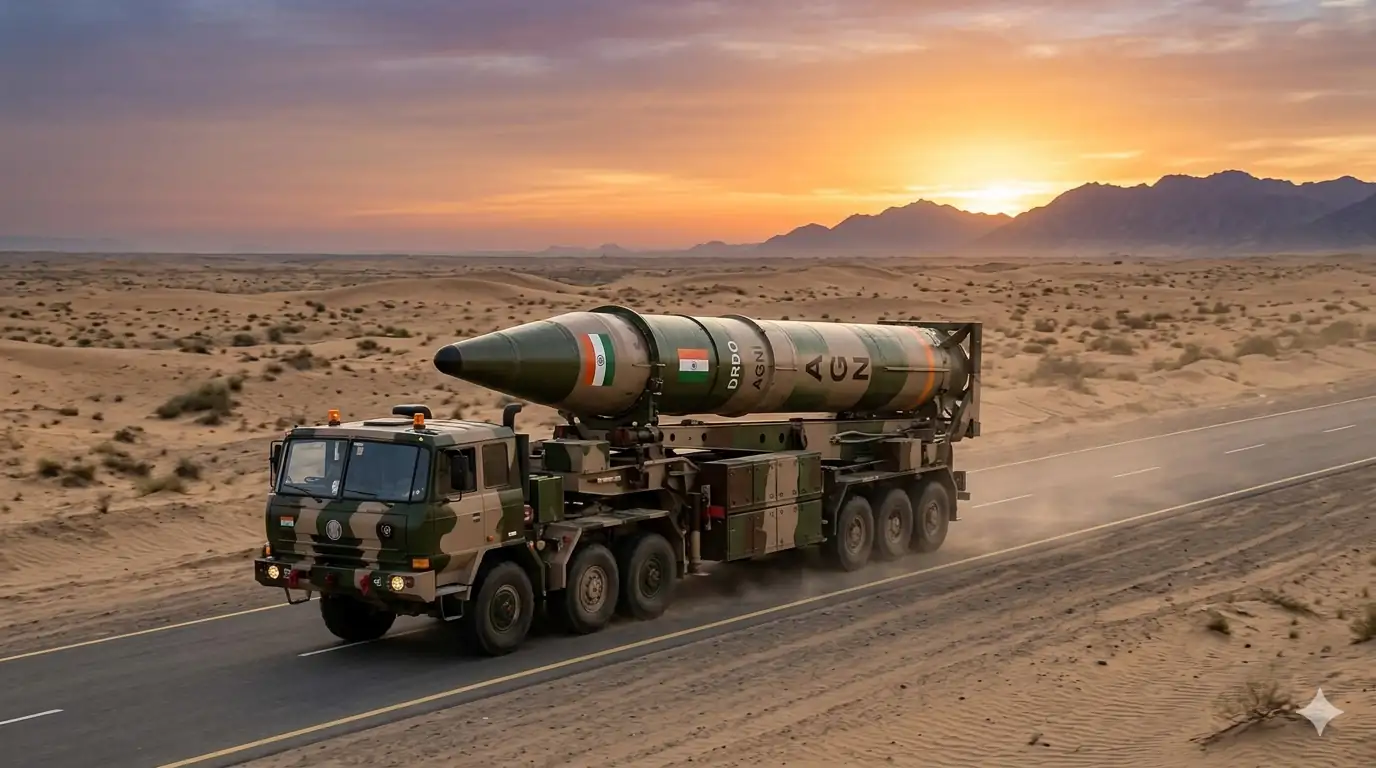
<p>At dawn on a humid morning off the coast of Odisha, military observers watched a long cylindrical shape rise through smoke and flame before disappearing into the sky over the Bay of Bengal.</p>
<p>No dramatic music. No public countdown.</p>
<p>Just a missile climbing fast enough to alter strategic calculations across Asia.</p>
<p>For India, the Agni missile program was never merely about rockets. It was about something deeper: surviving in a neighborhood shaped by nuclear rivals, border wars, and shifting global alliances.</p>
<p>Today, the <strong>Agni missile of India</strong> represents one of the most important pillars of the country’s strategic deterrence system. From the short-range Agni-I to the near intercontinental Agni-V, the program reflects decades of engineering, political caution, and military ambition.</p>
<p>But behind the headlines lies a more complex reality. The Agni series is not just a technological success story. It is also a message—to rivals, allies, and increasingly, to the world.</p>
<h3 class="wp-block-heading">What Is the Agni Missile Program?</h3>
<p>The Agni missile series is a family of Indian ballistic missiles developed primarily by Defence Research and Development Organisation under India’s Integrated Guided Missile Development Programme.</p>
<p>The word <em>Agni</em> means “fire” in Sanskrit. The symbolism is deliberate.</p>
<p>These missiles form a major part of India’s nuclear deterrence doctrine and are designed to deliver conventional or nuclear payloads over varying ranges.</p>
<p>Unlike battlefield rockets, ballistic missiles travel at extremely high speeds along a curved trajectory, making interception difficult. In strategic terms, they are less about fighting wars and more about preventing them.</p>
<p>That distinction matters.</p>
<h3 class="wp-block-heading">Why India Built the Agni Missile Series</h3>
<p>India’s missile program accelerated after several geopolitical shocks:</p>
<ul class="wp-block-list">
<li>The 1962 war with China</li>
<li>Repeated military tensions with Pakistan</li>
<li>China’s nuclear weapons development</li>
<li>Pakistan’s missile and nuclear advancements in the 1980s and 1990s</li>
</ul>
<p>India understood a hard truth of modern geopolitics: military vulnerability invites pressure.</p>
<p>The Agni series became India’s answer to strategic encirclement.</p>
<h3 class="wp-block-heading">Agni Missile Versions Explained</h3>
<h4 class="wp-block-heading">Agni-I</h4>
<p>Agni-I was developed after the 1999 Kargil conflict, when India realized it needed a quick-response missile capable of targeting strategic locations within Pakistan.</p>
<h4 class="wp-block-heading">Key Details</h4>
<ul class="wp-block-list">
<li><strong>First Test:</strong> 2002</li>
<li><strong>Status:</strong> Inducted</li>
<li><strong>Range:</strong> 700–900 km</li>
<li><strong>Speed:</strong> Around Mach 7</li>
<li><strong>Payload:</strong> ~1,000 kg</li>
<li><strong>Launch Platform:</strong> Road-mobile launcher</li>
<li><strong>Estimated Cost:</strong> Approx. ₹25–35 crore per missile</li>
</ul>
<p>Agni-I is compact compared to later variants, allowing rapid deployment across difficult terrain. Military planners value mobility because survivability matters as much as firepower in nuclear strategy.</p>
<h3 class="wp-block-heading">Agni-II</h3>
<h4 class="wp-block-heading">The First True Regional Deterrent</h4>
<p>Agni-II expanded India’s strike capability beyond Pakistan and deeper into Asia.</p>
<h4 class="wp-block-heading">Key Details</h4>
<ul class="wp-block-list">
<li><strong>First Test:</strong> 1999</li>
<li><strong>Status:</strong> Inducted</li>
<li><strong>Range:</strong> 2,000–3,000 km</li>
<li><strong>Speed:</strong> Around Mach 12</li>
<li><strong>Stages:</strong> Two-stage solid fuel missile</li>
<li><strong>Launch Capability:</strong> Rail and road mobile</li>
<li><strong>Estimated Cost:</strong> ₹35–50 crore</li>
</ul>
<p>This missile marked a strategic transition. India was no longer thinking only about immediate borders. The focus shifted toward regional deterrence.</p>
<h3 class="wp-block-heading">Agni-III</h3>
<h4 class="wp-block-heading">Built With China in Mind</h4>
<p>This is where the strategic message became impossible to ignore.</p>
<p>Agni-III was designed to target high-value locations deep inside China. Larger, heavier, and more powerful, it represented India’s entry into intermediate-range ballistic missile capability.</p>
<h4 class="wp-block-heading">Key Details</h4>
<ul class="wp-block-list">
<li><strong>First Successful Test:</strong> 2007</li>
<li><strong>Status:</strong> Inducted in limited numbers</li>
<li><strong>Range:</strong> 3,000–5,000 km</li>
<li><strong>Speed:</strong> Hypersonic terminal velocity</li>
<li><strong>Payload:</strong> 1.5 tonnes</li>
<li><strong>Special Feature:</strong> Improved navigation and accuracy</li>
<li><strong>Estimated Cost:</strong> ₹70 crore+</li>
</ul>
<p>Its sheer size required significant logistical support, but it also strengthened India’s second-strike credibility.</p>
<h3 class="wp-block-heading">Agni-IV</h3>
<h4 class="wp-block-heading">The Technological Leap</h4>
<p>Agni-IV often gets overshadowed by Agni-V, but military analysts quietly consider it one of the most important upgrades in the entire series.</p>
<p>Why?</p>
<p>Because this missile improved survivability, accuracy, and mobility simultaneously.</p>
<h4 class="wp-block-heading">Key Details</h4>
<ul class="wp-block-list">
<li><strong>First Test:</strong> 2011</li>
<li><strong>Status:</strong> Operational</li>
<li><strong>Range:</strong> 3,500–4,000 km</li>
<li><strong>Speed:</strong> Over Mach 20 during re-entry</li>
<li><strong>Weight:</strong> Much lighter composite structure</li>
<li><strong>Guidance:</strong> Ring laser gyro and micro-navigation systems</li>
<li><strong>Estimated Cost:</strong> ₹100 crore+</li>
</ul>
<p>This was the moment India’s missile program started looking technologically mature rather than merely functional.</p>
<h3 class="wp-block-heading">Agni-V</h3>
<h4 class="wp-block-heading">The Missile That Changed the Conversation</h4>
<p>When India tested Agni-V, international reactions shifted immediately.</p>
<p>This was no longer a regional missile.</p>
<p>It was a near-intercontinental ballistic missile capable of reaching large parts of Asia and beyond.</p>
<h4 class="wp-block-heading">Key Details</h4>
<ul class="wp-block-list">
<li><strong>First Test:</strong> 2012</li>
<li><strong>Status:</strong> Inducted</li>
<li><strong>Range:</strong> 5,000–5,500 km (some analysts believe higher)</li>
<li><strong>Speed:</strong> Mach 24+</li>
<li><strong>Stages:</strong> Three-stage solid-fuel missile</li>
<li><strong>Canister Launch:</strong> Yes</li>
<li><strong>Estimated Cost:</strong> ₹120–150 crore</li>
</ul>
<p>The canister-launch system is especially important. It allows missiles to remain sealed, mobile, and launch-ready for long periods. That dramatically improves response capability.</p>
<p>Agni-V also pushed India into a different strategic category globally.</p>
<h3 class="wp-block-heading">Agni-P (Agni Prime)</h3>
<h4 class="wp-block-heading">India’s Next-Generation Shift</h4>
<p>Agni-P reflects a broader military trend: smaller, smarter, more survivable systems.</p>
<h4 class="wp-block-heading">Key Details</h4>
<ul class="wp-block-list">
<li><strong>First Test:</strong> 2021</li>
<li><strong>Status:</strong> Under induction/testing</li>
<li><strong>Range:</strong> 1,000–2,000 km</li>
<li><strong>Features:</strong> Advanced guidance, lighter body, MIRV-ready architecture</li>
<li><strong>Launch:</strong> Canisterized</li>
<li><strong>Role:</strong> Precision strategic deterrence</li>
</ul>
<p>Many analysts see Agni-P as the future backbone of India’s regional deterrence system.</p>
<h3 class="wp-block-heading">Agni Missile Comparison Table</h3>
<figure class="wp-block-table"><table class="has-fixed-layout"><thead><tr><th>Missile</th><th>Range</th><th>Status</th><th>Speed</th><th>Main Strategic Focus</th></tr></thead><tbody><tr><td>Agni-I</td><td>700–900 km</td><td>Inducted</td><td>Mach 7</td><td>Pakistan-focused deterrence</td></tr><tr><td>Agni-II</td><td>2,000–3,000 km</td><td>Inducted</td><td>Mach 12</td><td>Regional strike capability</td></tr><tr><td>Agni-III</td><td>3,000–5,000 km</td><td>Limited induction</td><td>Hypersonic re-entry</td><td>China-focused reach</td></tr><tr><td>Agni-IV</td><td>3,500–4,000 km</td><td>Operational</td><td>Mach 20+</td><td>Precision + survivability</td></tr><tr><td>Agni-V</td><td>5,000–5,500 km</td><td>Inducted</td><td>Mach 24+</td><td>Near-ICBM deterrence</td></tr><tr><td>Agni-P</td><td>1,000–2,000 km</td><td>Testing/Induction</td><td>High supersonic/hypersonic</td><td>Modern tactical deterrence</td></tr></tbody></table></figure>
<h3 class="wp-block-heading">Why the Agni Program Is a Major Strategic Shift for India</h3>
<p>The Agni program changed India in three major ways.</p>
<h4 class="wp-block-heading">1. Credible Nuclear Deterrence</h4>
<p>India’s nuclear doctrine depends heavily on <em>credible minimum deterrence</em> and a <em>no first use</em> policy.</p>
<p>That doctrine only works if retaliation remains possible after an enemy strike.</p>
<p>Mobile Agni missiles improve survivability, making India’s deterrence more believable.</p>
<h4 class="wp-block-heading">2. Strategic Independence</h4>
<p>India historically depended on foreign military imports. The Agni series became proof that India could develop advanced strategic systems domestically.</p>
<p>That matters politically as much as militarily.</p>
<h4 class="wp-block-heading">3. Psychological Power</h4>
<p>Military systems are not only weapons. They are signals.</p>
<p>Agni-V especially altered how India is perceived globally. Nations now view India not merely as a regional military power, but as a country with long-range strategic reach.</p>
<h3 class="wp-block-heading">Who Feels Threatened by the Agni Missile Program?</h3>
<h4 class="wp-block-heading">Pakistan</h4>
<p>Pakistan views shorter-range Agni systems as direct strategic threats. Islamabad responded by developing systems like Shaheen and Babur missiles.</p>
<p>The rivalry created a classic South Asian missile race.</p>
<h4 class="wp-block-heading">China</h4>
<p>China is more concerned about Agni-IV and Agni-V.</p>
<p>Chinese analysts rarely express panic publicly, but Indian long-range missile development complicates Beijing’s regional calculations, especially after border tensions in Ladakh.</p>
<h4 class="wp-block-heading">Western Nonproliferation Circles</h4>
<p>Some arms-control experts worry that expanding missile ranges across Asia increase instability rather than security.</p>
<p>Critics argue:</p>
<ul class="wp-block-list">
<li>Missile races create escalation risks</li>
<li>Hypersonic delivery compresses decision time</li>
<li>Mobile launchers increase uncertainty during crises</li>
</ul>
<p>These concerns are not imaginary.</p>
<h3 class="wp-block-heading">What’s Not Being Said: India’s Missile Success Is Also About Geography</h3>
<p>One underreported reality is how geography shaped the Agni program.</p>
<p>India faces two nuclear neighbors with vastly different terrains:</p>
<ul class="wp-block-list">
<li>Mountain borders with China</li>
<li>Flat rapid-mobilization sectors near Pakistan</li>
<li>Coastal vulnerabilities in the Indian Ocean</li>
</ul>
<p>Missile mobility became essential because fixed launch sites are easier to target.</p>
<p>That is why canisterized launch systems matter so much. They allow movement across deserts, forests, highways, and hidden military corridors under operational secrecy.</p>
<p>In nuclear deterrence, survival is power.</p>
<h3 class="wp-block-heading">The Real Shift: India Is Quietly Building a More Survivable Nuclear Triad</h3>
<p>Agni missiles are only one piece of a larger transformation.</p>
<p>India is steadily moving toward a stronger nuclear triad:</p>
<ul class="wp-block-list">
<li>Land-based missiles</li>
<li>Air-delivered nuclear capability</li>
<li>Sea-based deterrence through submarines</li>
</ul>
<p>This matters because submarine-based deterrence is considered the hardest to destroy in a first strike.</p>
<p>In strategic terms, India is transitioning from basic deterrence toward assured retaliation capability.</p>
<p>That changes Asian military calculations significantly.</p>
<h3 class="wp-block-heading">What Happens Next?</h3>
<p>The next phase will likely focus on:</p>
<ul class="wp-block-list">
<li>MIRV technology (multiple warheads)</li>
<li>Faster launch readiness</li>
<li>Improved missile defense penetration</li>
<li>Hypersonic systems</li>
<li>Greater survivability</li>
</ul>
<p>The real geopolitical impact, however, extends beyond India.</p>
<p>As India’s missile capability grows, countries across Asia will adjust military planning, alliance structures, and defense spending accordingly.</p>
<p>Some nations will see stability through deterrence.</p>
<p>Others will see the beginning of a more dangerous arms competition.</p>
<p>Both interpretations may be true at the same time.</p>
<h3 class="wp-block-heading">The Question Hanging Over Asia</h3>
<p>For decades, India’s rise was measured through economics and diplomacy.</p>
<p>Now increasingly, it is measured through strategic reach.</p>
<p>The Agni missile program did not simply give India longer-range weapons. It gave New Delhi something every major power seeks but rarely admits openly:</p>
<p>The ability to shape how other nations calculate risk.</p>
<p></p>
<p>see more about<br><a href="https://nationnotifier.com/top-5-cruise-missiles-world-rankings-2025/" data-type="post" data-id="2236">Top 5 Most Powerful Cruise Missiles in the World (2025 Rankings)</a></p>
<p><a href="https://nationnotifier.com/brahmos-the-brahmastra-of-modern-warfare-and-indias-defence-superiority/" data-type="post" data-id="2283">BrahMos: The “Brahmastra” of Modern Warfare and India’s Defence Superiority</a></p>
At dawn on a humid morning off the coast of Odisha, military observers watched a long cylindrical shape rise through smoke and flame before disappearing into the sky over the Bay of Bengal.
No dramatic music. No public countdown.
Just a missile climbing fast enough to alter strategic calculations across Asia.
For India, the Agni missile program was never merely about rockets. It was about something deeper: surviving in a neighborhood shaped by nuclear rivals, border wars, and shifting global alliances.
Today, the Agni missile of India represents one of the most important pillars of the country’s strategic deterrence system. From the short-range Agni-I to the near intercontinental Agni-V, the program reflects decades of engineering, political caution, and military ambition.
But behind the headlines lies a more complex reality. The Agni series is not just a technological success story. It is also a message—to rivals, allies, and increasingly, to the world.
What Is the Agni Missile Program?
The Agni missile series is a family of Indian ballistic missiles developed primarily by Defence Research and Development Organisation under India’s Integrated Guided Missile Development Programme.
The word Agni means “fire” in Sanskrit. The symbolism is deliberate.
These missiles form a major part of India’s nuclear deterrence doctrine and are designed to deliver conventional or nuclear payloads over varying ranges.
Unlike battlefield rockets, ballistic missiles travel at extremely high speeds along a curved trajectory, making interception difficult. In strategic terms, they are less about fighting wars and more about preventing them.
That distinction matters.
Why India Built the Agni Missile Series
India’s missile program accelerated after several geopolitical shocks:
The 1962 war with China
Repeated military tensions with Pakistan
China’s nuclear weapons development
Pakistan’s missile and nuclear advancements in the 1980s and 1990s
India understood a hard truth of modern geopolitics: military vulnerability invites pressure.
The Agni series became India’s answer to strategic encirclement.
Agni Missile Versions Explained
Agni-I
Agni-I was developed after the 1999 Kargil conflict, when India realized it needed a quick-response missile capable of targeting strategic locations within Pakistan.
Key Details
First Test: 2002
Status: Inducted
Range: 700–900 km
Speed: Around Mach 7
Payload: ~1,000 kg
Launch Platform: Road-mobile launcher
Estimated Cost: Approx. ₹25–35 crore per missile
Agni-I is compact compared to later variants, allowing rapid deployment across difficult terrain. Military planners value mobility because survivability matters as much as firepower in nuclear strategy.
Agni-II
The First True Regional Deterrent
Agni-II expanded India’s strike capability beyond Pakistan and deeper into Asia.
Key Details
First Test: 1999
Status: Inducted
Range: 2,000–3,000 km
Speed: Around Mach 12
Stages: Two-stage solid fuel missile
Launch Capability: Rail and road mobile
Estimated Cost: ₹35–50 crore
This missile marked a strategic transition. India was no longer thinking only about immediate borders. The focus shifted toward regional deterrence.
Agni-III
Built With China in Mind
This is where the strategic message became impossible to ignore.
Agni-III was designed to target high-value locations deep inside China. Larger, heavier, and more powerful, it represented India’s entry into intermediate-range ballistic missile capability.
Key Details
First Successful Test: 2007
Status: Inducted in limited numbers
Range: 3,000–5,000 km
Speed: Hypersonic terminal velocity
Payload: 1.5 tonnes
Special Feature: Improved navigation and accuracy
Estimated Cost: ₹70 crore+
Its sheer size required significant logistical support, but it also strengthened India’s second-strike credibility.
Agni-IV
The Technological Leap
Agni-IV often gets overshadowed by Agni-V, but military analysts quietly consider it one of the most important upgrades in the entire series.
Why?
Because this missile improved survivability, accuracy, and mobility simultaneously.
Key Details
First Test: 2011
Status: Operational
Range: 3,500–4,000 km
Speed: Over Mach 20 during re-entry
Weight: Much lighter composite structure
Guidance: Ring laser gyro and micro-navigation systems
Estimated Cost: ₹100 crore+
This was the moment India’s missile program started looking technologically mature rather than merely functional.
Agni-V
The Missile That Changed the Conversation
When India tested Agni-V, international reactions shifted immediately.
This was no longer a regional missile.
It was a near-intercontinental ballistic missile capable of reaching large parts of Asia and beyond.
Key Details
First Test: 2012
Status: Inducted
Range: 5,000–5,500 km (some analysts believe higher)
Speed: Mach 24+
Stages: Three-stage solid-fuel missile
Canister Launch: Yes
Estimated Cost: ₹120–150 crore
The canister-launch system is especially important. It allows missiles to remain sealed, mobile, and launch-ready for long periods. That dramatically improves response capability.
Agni-V also pushed India into a different strategic category globally.
Agni-P (Agni Prime)
India’s Next-Generation Shift
Agni-P reflects a broader military trend: smaller, smarter, more survivable systems.
Many analysts see Agni-P as the future backbone of India’s regional deterrence system.
Agni Missile Comparison Table
Missile
Range
Status
Speed
Main Strategic Focus
Agni-I
700–900 km
Inducted
Mach 7
Pakistan-focused deterrence
Agni-II
2,000–3,000 km
Inducted
Mach 12
Regional strike capability
Agni-III
3,000–5,000 km
Limited induction
Hypersonic re-entry
China-focused reach
Agni-IV
3,500–4,000 km
Operational
Mach 20+
Precision + survivability
Agni-V
5,000–5,500 km
Inducted
Mach 24+
Near-ICBM deterrence
Agni-P
1,000–2,000 km
Testing/Induction
High supersonic/hypersonic
Modern tactical deterrence
Why the Agni Program Is a Major Strategic Shift for India
The Agni program changed India in three major ways.
1. Credible Nuclear Deterrence
India’s nuclear doctrine depends heavily on credible minimum deterrence and a no first use policy.
That doctrine only works if retaliation remains possible after an enemy strike.
Mobile Agni missiles improve survivability, making India’s deterrence more believable.
2. Strategic Independence
India historically depended on foreign military imports. The Agni series became proof that India could develop advanced strategic systems domestically.
That matters politically as much as militarily.
3. Psychological Power
Military systems are not only weapons. They are signals.
Agni-V especially altered how India is perceived globally. Nations now view India not merely as a regional military power, but as a country with long-range strategic reach.
Who Feels Threatened by the Agni Missile Program?
Pakistan
Pakistan views shorter-range Agni systems as direct strategic threats. Islamabad responded by developing systems like Shaheen and Babur missiles.
The rivalry created a classic South Asian missile race.
China
China is more concerned about Agni-IV and Agni-V.
Chinese analysts rarely express panic publicly, but Indian long-range missile development complicates Beijing’s regional calculations, especially after border tensions in Ladakh.
Western Nonproliferation Circles
Some arms-control experts worry that expanding missile ranges across Asia increase instability rather than security.
Critics argue:
Missile races create escalation risks
Hypersonic delivery compresses decision time
Mobile launchers increase uncertainty during crises
These concerns are not imaginary.
What’s Not Being Said: India’s Missile Success Is Also About Geography
One underreported reality is how geography shaped the Agni program.
India faces two nuclear neighbors with vastly different terrains:
Mountain borders with China
Flat rapid-mobilization sectors near Pakistan
Coastal vulnerabilities in the Indian Ocean
Missile mobility became essential because fixed launch sites are easier to target.
That is why canisterized launch systems matter so much. They allow movement across deserts, forests, highways, and hidden military corridors under operational secrecy.
In nuclear deterrence, survival is power.
The Real Shift: India Is Quietly Building a More Survivable Nuclear Triad
Agni missiles are only one piece of a larger transformation.
India is steadily moving toward a stronger nuclear triad:
Land-based missiles
Air-delivered nuclear capability
Sea-based deterrence through submarines
This matters because submarine-based deterrence is considered the hardest to destroy in a first strike.
In strategic terms, India is transitioning from basic deterrence toward assured retaliation capability.
That changes Asian military calculations significantly.
What Happens Next?
The next phase will likely focus on:
MIRV technology (multiple warheads)
Faster launch readiness
Improved missile defense penetration
Hypersonic systems
Greater survivability
The real geopolitical impact, however, extends beyond India.
As India’s missile capability grows, countries across Asia will adjust military planning, alliance structures, and defense spending accordingly.
Some nations will see stability through deterrence.
Others will see the beginning of a more dangerous arms competition.
Both interpretations may be true at the same time.
The Question Hanging Over Asia
For decades, India’s rise was measured through economics and diplomacy.
Now increasingly, it is measured through strategic reach.
The Agni missile program did not simply give India longer-range weapons. It gave New Delhi something every major power seeks but rarely admits openly:
The ability to shape how other nations calculate risk.