
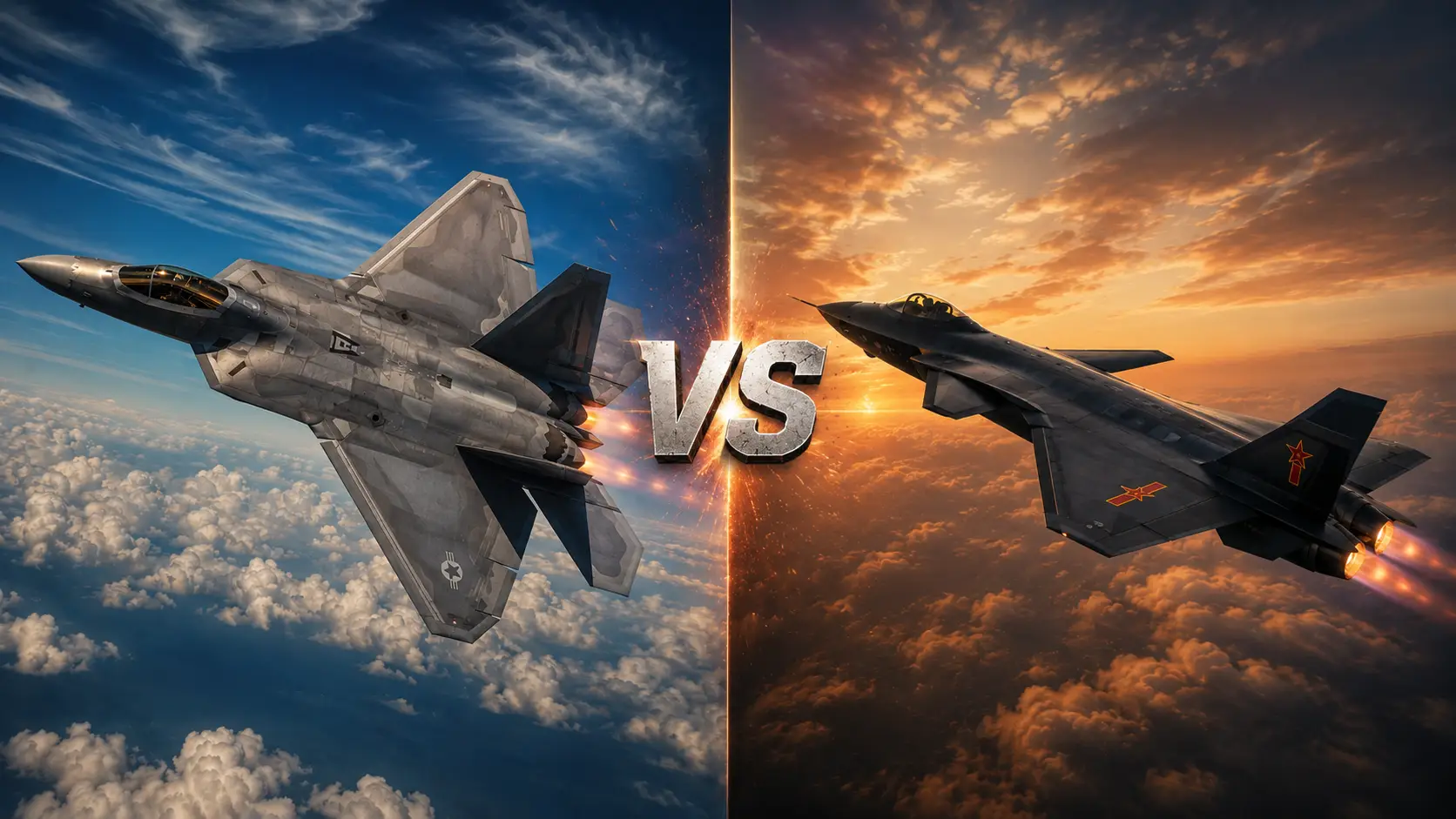
F-22 Raptor vs Chengdu J-20: Why This Comparison Actually Matters
F-22 Raptor vs Chengdu J-20 — two aircraft, two superpowers, one question that defence analysts keep returning to: if these jets ever meet over the Pacific, who comes home?
The F-22 Raptor entered service in 2005. The United States built 187 of them, shut the production line, and has not opened it since. The J-20 Mighty Dragon flew its first public sortie in 2018 and China has been building them at a pace that makes Western planners uncomfortable. On paper, both are fifth-generation air superiority fighters. In practice, they were designed around very different ideas of how a future war gets won.
This is not a spec sheet exercise. Specs matter, but the aircraft that wins a real war is not always the one with the higher thrust-to-weight ratio. It is the one that is available, networked, supported, and flown by pilots who know what they are doing. We will cover all of it — the stealth, the missiles, the engines, the ecosystems, and ultimately, the scenarios where each jet holds the advantage.
F-22 Raptor vs J-20 Mighty Dragon: Specifications at a Glance
| Specification | F-22 Raptor | J-20 Mighty Dragon |
| Role | Air superiority | Air superiority / Strike |
| First flight | 1997 | 2011 |
| Service entry | 2005 | 2017 |
| Top speed | Mach 2.25 | ~Mach 2.0 |
| Supercruise | Yes (Mach 1.8) | Limited / Contested |
| Service ceiling | 65,000 ft | ~66,000 ft |
| Combat radius | ~590 nm | ~1,000 nm (est.) |
| Thrust-to-weight | ~1.37 | ~1.05–1.25 (WS-15) |
| Engines | 2x Pratt & Whitney F119 | 2x WS-10C / WS-15 |
| Fleet size | ~183 airframes | ~200+ (growing) |
| Unit cost | ~$150 million | ~$100–120 million (est.) |
Stealth and Survivability: Where the F-22 Still Leads
Frontal vs All-Aspect Stealth
Both aircraft are built around low-observable design. But there is a meaningful difference in how each approaches it. The F-22 was designed from the ground up for all-aspect stealth — meaning it is hard to detect from the front, sides, and rear. The J-20 prioritizes frontal-aspect stealth, which is effective for long-range missile attacks where the jet is approaching head-on, but becomes less of an advantage in a turning engagement or when adversary radar is looking from off-angle.
The J-20’s canard-delta configuration — canard foreplanes at the front, delta wings — improves maneuverability but creates radar-reflective surfaces that a pure stealth aircraft like the F-22 avoids. The J-20 also uses canted tails similar to the F-22, which help, but the overall radar cross-section (RCS) from the side and rear is larger than the Raptor’s.
Engine Nozzle Design and Infrared Signature
The F-22 uses two-dimensional thrust-vectoring nozzles. These are flatter in profile, which reduces the infrared (heat) signature when viewed from certain angles. The J-20, using the WS-10C engine, relies on circular nozzles that are more visible to infrared sensors. This matters because modern beyond-visual-range combat increasingly involves infrared search and track (IRST) systems that do not emit radar signals and cannot be jammed in the traditional sense. The WS-15 engine expected to be standard-fit on future J-20 variants addresses some of this, but the nozzle design gap has not been closed.
Stealth vs Payload Trade-offs
Stealth requires internal weapons carriage. External pylons destroy an aircraft’s radar signature. The J-20 carries weapons internally but its larger airframe — 67 feet long vs the F-22’s 62 feet — gives it larger weapons bays and the ability to carry bigger missiles, including the PL-17 ultra-long-range missile. This is a deliberate trade-off: the J-20 accepts slightly higher RCS in exchange for a heavier punch at very long range.
Sensors and Situational Awareness: The J-20 Is Catching Up Fast
AESA Radar Comparison
The F-22 carries the AN/APG-77 AESA radar, one of the most mature and tested air combat radars in the world. It is excellent at detecting low-observable targets and has been refined through two decades of operational use. The J-20 is believed to carry a Type 1475 (KLJ-5) AESA radar with a physically larger aperture than the APG-77, which — if true — means it can gather more radar energy and potentially detect the F-22 at longer ranges than the Raptor can detect it. This is a point that most mainstream comparisons underplay. Aperture size is not everything in radar performance, but it is a major factor, and the J-20 may have an advantage here that is not yet fully understood in the open-source community.
Sensor Fusion and Pilot Workload
The F-22 was one of the first jets to implement true sensor fusion — where radar, electronic warfare, and passive sensor data are merged into one tactical picture for the pilot. The pilot does not see separate sensor feeds; he sees one integrated picture. This dramatically reduces workload in a high-pressure engagement. The J-20 has developed similar sensor fusion capabilities, but the maturity of its software and the depth of its integration with other platforms is less verified. PLAAF is working to close this gap, but operational doctrine and years of flying the system are things that cannot be purchased quickly.
Engines: The F119 vs WS-15 — A Closing Gap
The F-22’s F119 engines give it supercruise — the ability to fly supersonic without afterburner. This is tactically significant because afterburner produces enormous heat, making an aircraft highly visible to infrared sensors and significantly increasing fuel consumption. The F-22 can cruise at around Mach 1.8 without afterburner, meaning it can reposition rapidly without announcing itself.
The J-20 with the WS-10C engine cannot genuinely supercruise. The aircraft must use afterburner to go supersonic, which is both fuel-hungry and thermally visible. The WS-15 engine changes this equation. It is China’s most capable indigenous turbofan and reportedly brings the J-20’s thrust-to-weight ratio close to the F-22’s and grants it genuine supercruise. Integration of the WS-15 across the J-20 fleet is ongoing. When it is complete — likely by the late 2020s — one of the F-22’s clearest performance advantages narrows considerably.
Missile Arsenal: The J-20 Hits Harder at Long Range
AIM-120D vs PL-15
Within the current inventory, the most important air-to-air matchup is the AIM-120D versus the PL-15. The AIM-120D is the latest variant of the AMRAAM family, with a range estimated above 100 miles and a two-way datalink that allows for mid-course guidance updates. The PL-15 is China’s answer, and by most credible estimates it matches or exceeds the AIM-120D in range — potentially reaching 200 km or more in some variants. The PL-15 was specifically designed to defeat AWACS and tanker aircraft at extreme range, which are the support assets that multiply American air power. Shooting at the support ecosystem rather than just the fighters is a deliberate Chinese strategic choice.
AIM-9X vs PL-10 — Within Visual Range
At short range, the AIM-9X Block II is a highly agile infrared missile with high-off-boresight capability — meaning it can be cued by a pilot’s helmet-mounted display to engage a target that is not directly ahead of the jet. The PL-10 is China’s equivalent and is assessed to be broadly comparable. Within-visual-range combat between these two jets would largely come down to pilot skill and aircraft maneuverability rather than missile superiority.
PL-17: The Ultra-Long-Range Threat
The PL-17 is a weapon the F-22 has no direct equivalent to in current inventory. It is an extremely long-range air-to-air missile — some open-source estimates put its range at over 300 km — designed to engage high-value, low-maneuverability targets. Its existence reflects J-20 doctrine: engage support aircraft (tankers, AWACS, ISR platforms) before they can feed data to front-line fighters. Degrade the network, and the F-22 flies partially blind. This is a smarter approach than trying to win a dogfight against the Raptor.
Pilot Experience and Combat Culture: The Intangible Advantage
The US Air Force pilot training pipeline is the most combat-tested in the world. F-22 pilots fly against adversary aircraft in dedicated aggressor squadrons, participate in Red Flag exercises that simulate realistic multi-domain combat, and operate within a culture of after-action learning that has been refined through decades of actual warfare. The F-22 fleet has not fired a shot in air-to-air combat, but its pilots train for it against every realistic threat scenario available.
The PLAAF has made significant strides in pilot training quality over the past decade. Training hours per pilot have increased, realistic combat exercises are now standard, and the force has shed its historical over-reliance on ground-controlled intercept doctrine — where pilots followed controller instructions rather than exercising independent judgment. However, the PLAAF has not fought a significant air-to-air war since the 1950s Korean conflict. That absence of real combat experience creates uncertainty about how its pilots and doctrine perform when the plan meets reality.
This is not an argument that the PLAAF cannot fight effectively. It is an acknowledgment that untested capability is different from proven capability. The F-22’s battle-tested pilot ecosystem is one advantage that does not appear in any spec comparison.
Fleet Size and Wartime Sustainability
This is the argument that is most consistently underweighted in popular comparisons. The F-22 fleet consists of approximately 183 operational airframes. Production ended in 2011 with no plans to restart. The aircraft is aging, and its mission-capable rate has hovered around 50% — meaning at any given time, roughly half the fleet is ready to fly. Against a major peer adversary, that is a serious constraint.
China is producing J-20s at a rate estimated between 60 and 100 airframes per year. Total fleet size is estimated at over 200 aircraft and growing. More importantly, the production line is open. If China loses J-20s in combat, it can replace them. If the United States loses F-22s, it cannot. Every Raptor attrited in a conflict is permanently gone.
CSIS wargames modeling a Taiwan conflict scenario have repeatedly shown that the primary threat to US aircraft is not being shot down in air combat — it is being destroyed on the ground by Chinese ballistic and cruise missile strikes on forward bases. A small, irreplaceable fleet concentrated on vulnerable forward bases is a genuine strategic liability. This is less about which jet is better and more about which air force can sustain a campaign. On that metric, China’s industrial capacity is a powerful asymmetric advantage.
Fighters Do Not Fight Alone
No fifth-generation fighter wins a war by itself. The aircraft is one node in a system-of-systems battle that includes AWACS (airborne early warning), air refueling tankers, satellite-based intelligence, ground radar networks, and secure datalinks between all of them. This context is almost always missing from F-22 vs J-20 comparisons, and its absence skews the analysis.
The US Air Force has spent decades building and exercising this integrated network. The E-3 Sentry and now the E-7 Wedgetail AWACS platforms extend the F-22’s situational awareness far beyond its onboard radar range. Tanker coverage allows Raptors to stay on station for extended periods. The F-22’s datalink connects it to the broader Joint All-Domain Command and Control (JADC2) architecture. When the F-22 fights, it fights with the accumulated situational awareness of an entire networked force behind it.
China has built its own version of this. The KJ-2000 and KJ-500 AWACS aircraft provide coverage, and China’s ground-based radar network in the Western Pacific is dense and overlapping. The J-20 is designed to operate within this network, with the PL-15’s range specifically tuned to reach US support assets. China’s anti-access/area-denial (A2/AD) strategy is built around degrading the American support network before engaging in fighter combat. In this framing, the question is not just F-22 vs J-20 — it is whether the US support ecosystem can survive long enough for the Raptor to matter.
Both Aircraft Have Export Bans — And That Reveals Something Important
The F-22 is the only major US combat aircraft never exported to an ally. Congress passed the Obey Amendment in 1998 prohibiting F-22 exports, driven by concerns about technology security. Japan, Australia, and Israel all asked — all were refused. The US instead sells the F-35, which is a capable aircraft but not the same as the Raptor. American allies in the Pacific are operating without the United States’ most capable air superiority platform.
China does not publicly publish an export ban on the J-20, but the aircraft has not been offered to any nation. China is instead selling the J-10C and developing the J-35 for export. This mirrors American behavior: keep your best capability domestic, export the second tier. What both export policies reveal is how seriously each government regards its premier fighter’s technology. Neither country is willing to risk an ally’s security breach compromising the crown jewel of its air power. That tells you more about how valuable these aircraft really are than any marketing brochure.
Network-Centric Warfare and the F-22’s Integration Challenge
The F-22 has an unusual problem for a cutting-edge aircraft: it was designed before the full network-centric warfare era and uses an older, proprietary Intra-Flight Data Link (IFDL) that does not communicate natively with the F-35’s advanced CNI system or the broader Link 16 network in receive-only mode. This means the F-22 can receive some datalinked information but cannot transmit on the standard network without a gateway aircraft. In a mixed-package operation, the Raptor is partially isolated from the information ecosystem its wingmen are sharing.
The US Air Force has been working to address this through software upgrades, and the F-22’s integration with the F-35 — where the F-35 acts as a forward sensor node and the F-22 acts as the shooter — is a recognized and practiced tactic. But the datalink limitation is a real constraint that matters in a high-tempo, multi-aircraft engagement where real-time information sharing between platforms can determine who sees a target first.
Who Would Win? Scenario-Based Analysis
One-on-One Dogfight
The F-22 wins. Thrust vectoring, all-aspect stealth, and supercruise give it control of the engagement geometry. The J-20 was not designed primarily for close-range turning fights, and its lack of a cannon — something the F-22 carries — is a tactical limitation at knife-fight range. Chinese simulations have reportedly assessed the J-20’s chance of victory against the F-22 in a pure dogfight at under 10%.
One-on-One Beyond Visual Range
This is closer. The J-20’s PL-15 matches or exceeds the AIM-120D in range. Its potentially larger AESA radar may detect the F-22 first. The F-22’s all-aspect stealth and supercruise give it energy and survivability advantages. A realistic assessment is that the F-22 retains an edge, but it is no longer the overwhelming one-sided advantage it would have been a decade ago.
Taiwan Conflict Scenario
Neither aircraft fights alone here. China’s A2/AD network — ballistic missiles, long-range SAMs, ASAT capabilities — complicates US power projection significantly. The J-20’s numerical advantage grows more relevant as the campaign extends. US tanker and AWACS losses reduce F-22 effectiveness dramatically. Forward basing on Guam, Okinawa, and the Philippines is within range of Chinese missile systems. This scenario is far less favorable for the US than a simple aircraft-to-aircraft comparison suggests, which is why American strategists are investing heavily in distributed basing, longer-range systems, and the sixth-generation F-47.
2030 Scenario: F-22 Upgraded vs WS-15-Powered J-20
By 2030, the WS-15 engine is likely standard across the J-20 fleet. This closes the supercruise gap and improves the J-20’s thrust-to-weight ratio significantly. The F-22 fleet will be 25+ years old, and while upgrades are ongoing, the aircraft is approaching the limits of what airframe modernization can achieve. The F-47 next-generation air dominance aircraft is in development but not yet fielded. The window of clear F-22 superiority is narrowing, and both sides know it.
Final Verdict: Stealth Alone Will Not Decide the Next Air War
The F-22 is still the more capable aircraft in a one-on-one engagement. Its all-aspect stealth, thrust-vectoring agility, supercruise, and sensor fusion maturity give it real advantages that the J-20 has not yet fully matched. The decades of USAF pilot combat experience and the depth of the American training ecosystem add a layer of capability that does not appear in any specification table.
But the F-22 is one jet in one air force. The J-20 is one jet in an air force that is producing new airframes every week, building a dense and overlapping A2/AD network across the Western Pacific, and fielding missiles specifically designed to destroy the American support architecture that makes the Raptor so effective. China does not need to build a better F-22. It needs to build a system that defeats the system the F-22 depends on.
The next major air war over the Pacific — if it happens — will not be decided by which aircraft has a lower radar cross-section. It will be decided by which side can sustain its operations under fire, keep its support networks functioning, and adapt faster to a degraded environment. On those questions, the outcome is far less certain than a simple F-22 vs J-20 spec comparison implies.
That uncertainty is exactly why both the United States and China are already developing their sixth-generation aircraft. The Raptor and the Dragon are not the last word — they are the setup for what comes next.
see more about
HAL Tejas Mk2 vs Rafale: Why India’s 4.5 Gen Powerhouse is the Ultimate Game-Changer
India’s Fighter Jets in 2026: Rafale, Su-30MKI, Tejas
HAL Prachand: How India’s Indigenous Light Combat Helicopter Dominates the Himalayas