
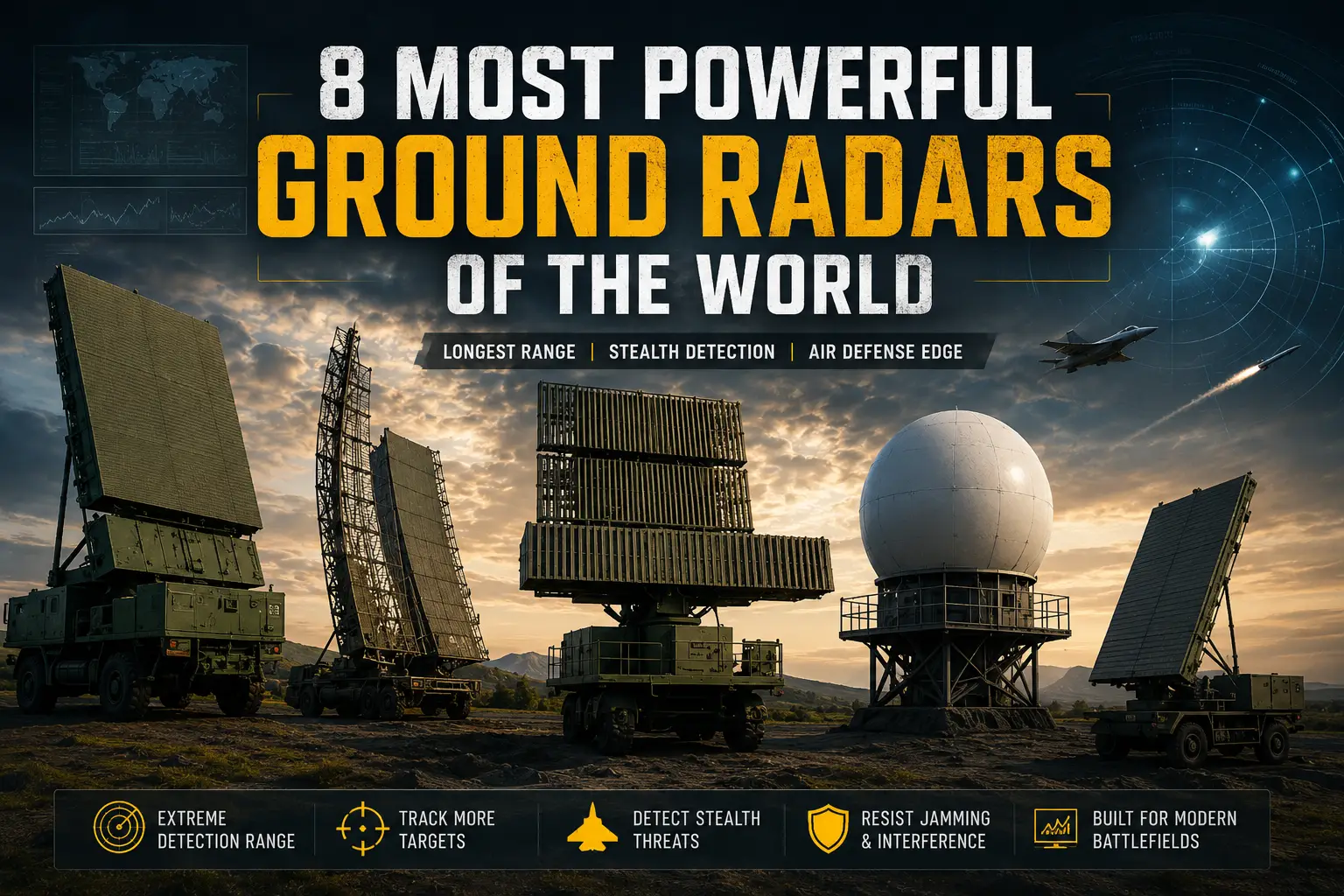
Ground radar is one of the quiet forces behind modern air defense. It watches before a missile is launched, before a jet crosses the border, and before a commander even knows a threat is coming. The most important systems today are not only the ones with the longest reach, but also the ones that can track more targets, resist jamming, detect stealth, and keep working through software updates.
Below are eight of the most significant ground radar systems in service today, ranked mainly by detection range, but also judged by track quality, mission flexibility, and strategic value.
1. Voronezh-DM — Russia
Voronezh-DM is Russia’s long-range early-warning radar family and one of the clearest examples of strategic sensing at scale. It is a fixed solid-state phased-array system built for ballistic-missile warning, space monitoring, and wide-area air and missile surveillance. Open sources place its ballistic detection range around 6,000 km, with much shorter but still very large aircraft detection coverage depending on target and mode.
- Country: Russia
- Year of development: 2012
- Range: about 6,000 km for ballistic targets, around 4,000 km for aircraft in some references
- Simultaneous targets: several hundred ballistic objects, exact figure not officially published
- Target types: ICBMs, SLBMs, ballistic vehicles, high-altitude aircraft, space objects
- Technology: VHF/UHF solid-state phased array
- Power: classified
- Multi-mission versatility: strategic early warning, missile warning, and space surveillance
- LPI: not designed as a low-probability-of-intercept system
- Software-defined upgrades: yes, through modern solid-state architecture
- Underrated point 1: fast rebuild time makes it far easier to replace than older Soviet-era systems.
- Underrated point 2: it also gives Russia useful space situational awareness as a side effect of missile tracking.
2. AN/FPS-132 UEWR — United States
The AN/FPS-132 Upgraded Early Warning Radar is one of the core sensors in the U.S. ballistic missile warning network. It is a UHF phased-array system that supports early detection of intercontinental missile launches and helps feed the broader missile defense architecture used by the U.S. and allies. Its range is commonly described as 5,000 km or more for ICBM detection and track support.
- Country: United States
- Year of development: modernized from older early-warning architecture
- Range: 5,000+ km for ballistic missile warning
- Simultaneous targets: classified, but built for large-scale salvo environments
- Target types: ICBMs, SLBMs, re-entry vehicles, space objects
- Technology: UHF phased array
- Power: classified
- Multi-mission versatility: mostly strategic missile warning, but highly networked
- LPI: not applicable in the usual sense
- Software-defined upgrades: yes, through continuous modernization
- Underrated point 1: its real value comes from the warning time it creates for the wider system.
- Underrated point 2: it multiplies the value of other sensors by feeding shared missile-defense networks.
3. Swordfish Long Range Tracking Radar — India
Swordfish is India’s key long-range ballistic tracking radar and a major part of the country’s missile defense architecture. Open reporting links it to the Green Pine lineage, but it has been steadily indigenized and upgraded by DRDO into a distinctly Indian system. It is designed to track ballistic threats at very long range and also supports space surveillance tasks.
- Country: India
- Year of development: 2010
- Range: about 1,500 km for ballistic tracking
- Simultaneous targets: dozens of ballistic objects
- Target types: ballistic missiles, re-entry vehicles, space objects
- Technology: X-band AESA
- Power: classified
- Multi-mission versatility: strong for missile defense cueing, with secondary space tracking value
- LPI: yes, narrow-beam X-band operation helps reduce intercept risk
- Software-defined upgrades: yes, with room for future hypersonic-tracking improvements
- Underrated point 1: India’s two-front threat geometry pushed this radar family into unusually hard problems.
- Underrated point 2: it adds meaningful space situational awareness beyond pure missile defense.
4. AN/TPY-2 — United States
AN/TPY-2 is one of the most respected missile-defense radars in the world. It is a transportable X-band phased-array radar used in both forward-based and terminal modes, which gives it a rare mix of strategic early warning and fire-control support. Open sources describe it as capable of tracking multiple missile classes and identifying small objects at long distance.
- Country: United States
- Year of development: 2005 operational fielding
- Range: 1,000+ km in forward-based mode, shorter in terminal mode
- Simultaneous targets: classified
- Target types: short-, medium-, and intermediate-range ballistic missiles, re-entry vehicles
- Technology: X-band AESA
- Power: classified
- Multi-mission versatility: strong, because it can serve both as a forward sensor and a terminal defense radar
- LPI: yes, narrow steerable beam supports low intercept risk
- Software-defined upgrades: yes, especially for discrimination improvements
- Underrated point 1: one deployment can improve the effectiveness of several connected missile-defense layers.
- Underrated point 2: X-band resolution gives it a real edge in warhead-versus-decoy discrimination.
5. 91N6E Big Bird — Russia
The 91N6E is the surveillance radar tied to Russia’s S-400 system. It is not an AESA radar, but it remains important because of its mobility, range, and the way it supports the wider S-400 network. Open reporting places its surveillance range near 600 km, with the ability to support detection and tracking of many aerial and missile threats.
- Country: Russia
- Year of development: 2007
- Range: about 600 km surveillance range
- Simultaneous targets: around 300 tracked, with about 36 engaged simultaneously in the broader system
- Target types: fighter aircraft, stealth aircraft, ballistic missiles, cruise missiles, UAVs, hypersonic targets
- Technology: PESA with frequency-agile waveforms
- Power: classified
- Multi-mission versatility: high within the S-400 ecosystem
- LPI: limited compared with modern AESA systems
- Software-defined upgrades: yes, through later variants and waveform changes
- Underrated point 1: mobility makes it harder to pre-target than a fixed strategic radar.
- Underrated point 2: export use gives Russia strategic insight into foreign air-defense environments.
6. YLC-8B — China
YLC-8B is one of China’s more important anti-stealth ground radars. It uses UHF phased-array architecture, which is useful for detecting aircraft designed to be hard to see on higher-frequency radars. Open sources place its conventional detection range around 500 to 600 km, with lower numbers against low-observable targets.
- Country: China
- Year of development: 2014 public reveal, operational use later in the decade
- Range: 500–600 km, depending on target type
- Simultaneous targets: around 200 surveillance objects, with many active tracks
- Target types: conventional aircraft, stealth aircraft, cruise missiles, low-altitude penetrators
- Technology: UHF phased array
- Power: estimated in open sources, but not officially confirmed
- Multi-mission versatility: moderate, mainly a stealth-detection and cueing radar
- LPI: limited, because UHF systems are easier to notice than narrow-beam X-band radars
- Software-defined upgrades: yes, through modern tracking software
- Underrated point 1: it does not need fire-control precision to be valuable.
- Underrated point 2: it can cue higher-frequency radars that then finish the track.
7. ELM-2080 Green Pine — Israel
Green Pine is a cornerstone of Israel’s Arrow missile defense network. It is an X-band AESA radar designed for ballistic missile detection, tracking, and fire-control support. Open sources commonly place its range around 500 km, with the larger Super Green Pine variant extending beyond that.
- Country: Israel
- Year of development: 1998
- Range: about 500 km for the original Green Pine family
- Simultaneous targets: around 30 ballistic targets in fire-control track
- Target types: ballistic missiles, re-entry vehicles
- Technology: X-band AESA
- Power: classified
- Multi-mission versatility: focused, but highly effective in its narrow role
- LPI: better than older radar types, though not its main public feature
- Software-defined upgrades: yes, through repeated modernization
- Underrated point 1: it has shaped enemy missile thinking by forcing better penetration and decoy design.
- Underrated point 2: it fits into a deeply networked U.S.-Israel missile-defense architecture.
8. TRML-4D — Germany
TRML-4D is Germany’s modern tactical radar from Hensoldt and one of the most flexible air-defense radars in service. It is a C-band AESA radar with GaN modules and strong software flexibility, making it useful against aircraft, drones, cruise missiles, rockets, and artillery threats. While its range is shorter than the strategic systems above, its versatility is exceptional.
- Country: Germany
- Year of development: 2019
- Range: about 250 km
- Simultaneous targets: around 1,500 objects per scan, with roughly 200 tracks
- Target types: fighter aircraft, cruise missiles, UAVs, rockets, mortar rounds
- Technology: C-band AESA with GaN solid-state modules
- Power: not officially published
- Multi-mission versatility: very high
- LPI: yes, modern AESA beam control supports low-observability modes
- Software-defined upgrades: yes, open architecture helps rapid improvement
- Underrated point 1: it may be the most useful tactical radar on the list for mixed battlefield threats.
- Underrated point 2: battlefield feedback from Ukraine has likely improved its software maturity quickly.
Closing Note
Range gets attention, but radar value is really about what happens after the first detection. The best systems do three things well: they see far, they see clearly, and they stay useful after the battlefield changes. That is why the future belongs to radars that are not just powerful, but adaptable.
see more about
7 Brutal Truths About Global Strike Capability: How ICBMs Can Hit Any Target on Earth
7 Deadliest India Made Missiles You Should Know
Top 5 Most Powerful Cruise Missiles in the World (2025 Rankings)