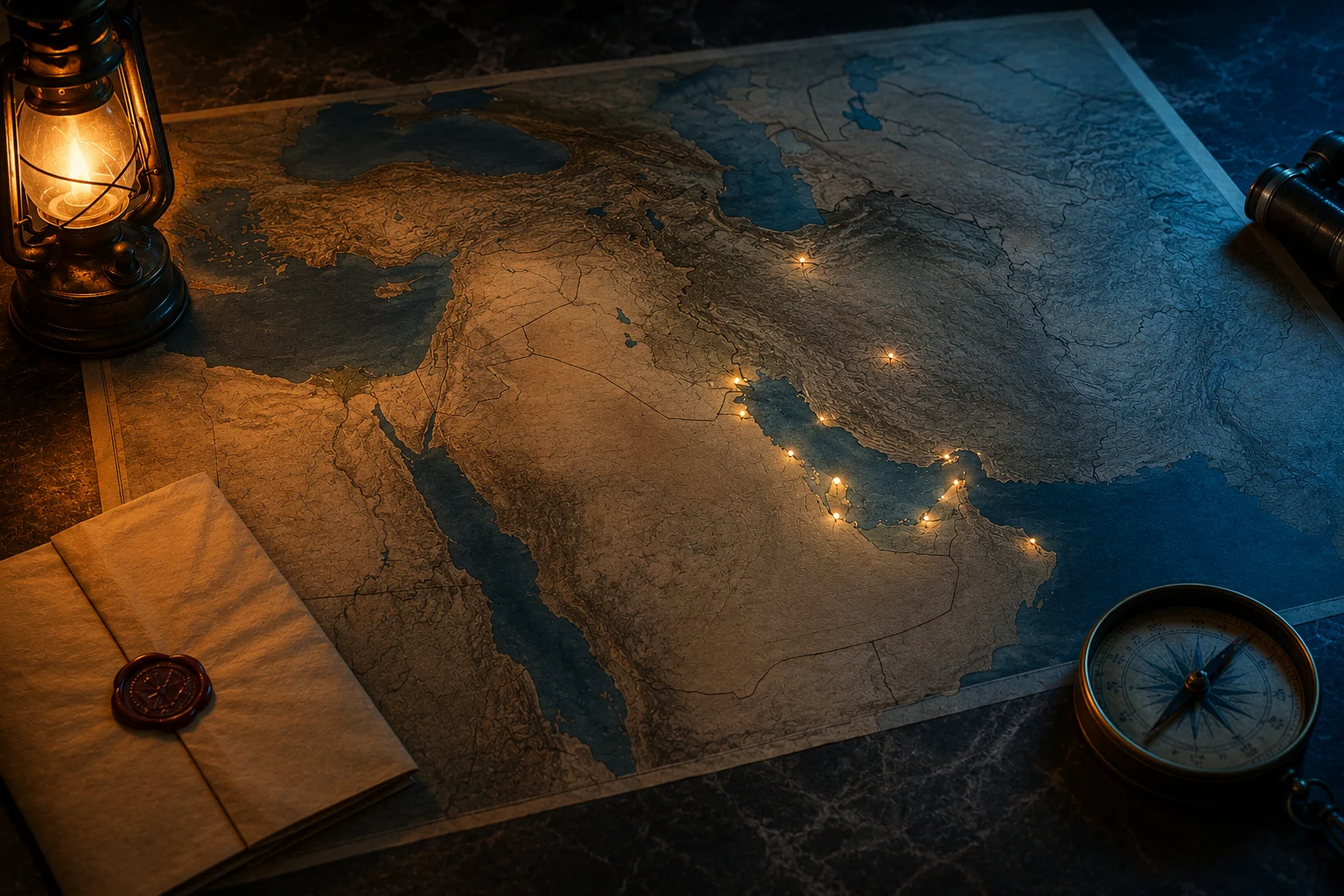
<p><strong>Gulf countries and Iran rivalry</strong> is not a new story. But every time tensions rise between Iran, Israel, and the United States, the same question comes up across social media, dinner tables, and news comment sections: why are Arab Gulf states staying quiet? Why aren’t Saudi Arabia, the UAE, Kuwait, or Bahrain standing behind Iran when the bombs are falling and the threats are flying?</p>
<p>They are all Muslim-majority countries. Many of their populations feel deep sympathy for Palestine and anger toward Washington and Tel Aviv. So the silence — or worse, the quiet diplomatic coordination with Western powers — looks, to many observers, like betrayal.</p>
<p>But the real answer is not betrayal. It is history. And that history goes back more than fifty years.</p>
<h3 class="wp-block-heading">The Moment Everything Changed: Iran in 1979</h3>
<p>To understand the Gulf countries and Iran rivalry today, you have to go back to the Iranian Revolution of 1979. Before that, Iran under the Shah was actually a regional ally of the Gulf monarchies and had close ties with the United States.</p>
<p>The revolution changed everything overnight.</p>
<p>The new Islamic Republic under Ayatollah Khomeini did not just want to govern Iran — it wanted to export its revolutionary model across the Muslim world. That idea terrified the kings and emirs sitting in Riyadh, Abu Dhabi, and Kuwait City. Their ruling systems were based on dynastic monarchy and tribal loyalty, not religious revolution. An Iran that was actively encouraging uprisings and regime change next door was not a neighbor — it was an existential problem.</p>
<p>That fear has never fully gone away. Nearly five decades later, it still shapes how Gulf governments see Tehran.</p>
<h3 class="wp-block-heading">The Saudi-Iran Power Contest That Defines the Region</h3>
<p>No relationship in the Middle East carries more weight than the one between Saudi Arabia and Iran. These two countries have been in a slow-motion rivalry for regional dominance for decades, and that rivalry sits at the heart of why Gulf states are not lining up behind Iran right now.</p>
<p>Look at where the two sides have ended up in nearly every major conflict:</p>
<p><strong>Syria:</strong> Iran backed Bashar al-Assad’s government with money, weapons, and fighters. Saudi Arabia and the UAE funded and armed opposition groups trying to bring him down. They were on opposite sides of the same war.</p>
<p><strong>Yemen:</strong> The Iran-aligned Houthi movement took control of large parts of the country. Saudi Arabia launched a military coalition to push them back. Riyadh has accused Tehran of supplying the Houthis with missiles, drones, and military training — accusations Iran denies but that Western intelligence agencies largely support. Thousands of Saudi civilians have been killed in Houthi strikes on Saudi territory. Expecting Riyadh to now stand with Tehran is not realistic.</p>
<p><strong>Lebanon:</strong> Iran built Hezbollah into one of the most heavily armed non-state groups in the world. Gulf governments — particularly Bahrain and Saudi Arabia — have designated Hezbollah as a terrorist organization. From their perspective, Iran has used Hezbollah as a tool to extend its influence into Arab territory and destabilize a neighboring government.</p>
<p>The Gulf countries and Iran rivalry is not about religion. It is about who controls the neighborhood. And for decades, Iran and the Gulf states have been pulling in opposite directions on almost every major question.</p>
<h3 class="wp-block-heading">Why Gulf Governments See Iran as a Security Threat — Not an Ally</h3>
<p>This point is important to say clearly, because it often gets lost in the coverage.</p>
<p>Gulf governments do not primarily see Iran as a fellow Muslim country that shares their values. They see it as a state that has, over decades, actively worked to undermine their governments, fund their opponents, and project power into their territories.</p>
<p>Bahrain is the clearest example. The country’s Shia-majority population has long been governed by a Sunni royal family, and Bahrain has accused Iran — repeatedly and specifically — of funding political opposition groups and armed cells on the island. Whether those accusations are always accurate is debated, but the perception runs deep enough to shape policy entirely.</p>
<p>Saudi Arabia expelled Iranian diplomats in 2016 after its embassy in Tehran was stormed by protesters following the execution of a Shia cleric. The two countries only resumed diplomatic ties in 2023 through a China-brokered deal — a deal that is still fragile and does not mean the strategic rivalry has ended.</p>
<p>For Gulf security planners, Iran is not a potential partner. It is a country they spend serious resources monitoring, containing, and building defenses against.</p>
<h3 class="wp-block-heading">The Islands Nobody Talks About: UAE and Iran’s Territorial Dispute</h3>
<p>Here is a detail that rarely makes it into mainstream coverage but matters a great deal for understanding why the UAE, in particular, has such a complicated relationship with Iran.</p>
<p>Three islands in the Persian Gulf — <strong>Abu Musa, Greater Tunb, and Lesser Tunb</strong> — are claimed by the UAE but have been under Iranian control since 1971. Iran seized them the same year the UAE was founded as an independent state.</p>
<p>The UAE has never accepted this. It raises the issue at every available international forum, including the Arab League and the United Nations. Iran considers the matter closed and the islands Iranian territory.</p>
<p>You cannot ask a country to stand in solidarity with a neighbor that is occupying its land. The UAE’s reluctance to support Iran is not just about geopolitics — it is personal, in the way that territorial disputes always are.</p>
<h3 class="wp-block-heading">The Economy Has a Vote Too</h3>
<p>Modern Gulf states have spent the last two decades building something remarkable. The UAE has turned Dubai and Abu Dhabi into global hubs for finance, tourism, logistics, and technology. Saudi Arabia is in the middle of its Vision 2030 transformation, trying to diversify away from oil dependence. Qatar is hosting global events and building out its soft power. Kuwait, Bahrain, and Oman all have significant economic reform agendas underway.</p>
<p>A regional war centered on Iran would put all of that at risk — fast.</p>
<p>The Strait of Hormuz, through which roughly 20 percent of the world’s oil passes, sits between Iran and the Gulf states. Any serious military escalation involving Iran immediately raises the question of whether that strait gets blocked or mined. Oil prices spike, shipping insurance becomes unaffordable, and foreign investors — who are essential to every Gulf diversification plan — start pulling back.</p>
<p>The Gulf countries and Iran rivalry, when seen through an economic lens, becomes even clearer. These governments have far more to protect than they have to gain. They want stability badly enough to be willing to absorb a lot of political criticism from their own populations to preserve it.</p>
<p>You can read more about how Gulf economies have evolved and their strategic vulnerabilities at <a href="https://www.cfr.org/region/persian-gulf">the Council on Foreign Relations’ Gulf region analysis</a> and <a href="https://carnegieendowment.org/topics/middle-east">the Carnegie Endowment for International Peace’s Middle East program</a>.</p>
<h3 class="wp-block-heading">The American Factor: You Cannot Ignore the Bases</h3>
<p>There is a practical reality that shapes Gulf foreign policy more than almost anything else: most Gulf countries host American military installations on their soil.</p>
<p>The U.S. Fifth Fleet is based in Bahrain. Al Udeid Air Base in Qatar is one of the largest American military facilities in the Middle East. The UAE and Saudi Arabia both have defense cooperation agreements with Washington that include arms sales, intelligence sharing, and security guarantees.</p>
<p>These are not small arrangements that can be quietly set aside. They are the backbone of Gulf security planning. They exist precisely because Gulf governments have decided that American protection is a more reliable guarantee of their survival than any regional alliance — including one with Iran.</p>
<p>Openly siding with Tehran in a confrontation with Washington would not just strain diplomatic ties. It would call into question the entire security architecture these governments have built over fifty years. No Gulf leader is going to do that.</p>
<p>For context on these military arrangements and their regional implications, <a href="https://www.aljazeera.com/news/2024/1/us-military-bases-middle-east">Al Jazeera’s coverage of US military presence in the Gulf</a> provides useful detail.</p>
<h3 class="wp-block-heading">The Gulf Is Not One Bloc — The Differences Matter</h3>
<p>Anyone writing seriously about this topic has to resist the temptation to treat “Gulf states” as a single actor with a single view. They are not.</p>
<p><strong>Saudi Arabia and the UAE</strong> are the most cautious about Iran, the most focused on containing its regional influence, and the most aligned with the American security framework.</p>
<p><strong>Bahrain</strong> has historically been the most directly confrontational with Tehran, driven largely by its domestic sectarian dynamics and specific accusations of Iranian interference.</p>
<p><strong>Kuwait</strong> tends toward a quieter, more neutral position — it has a significant Shia population and tries to avoid being drawn into the Saudi-Iran binary when possible.</p>
<p><strong>Oman</strong> is the genuine outlier. Muscat has maintained functional relations with Tehran for decades and has repeatedly served as a back-channel for Iran-US communications, including during nuclear deal negotiations. Oman does not see neutrality as a weakness — it sees it as a strategic asset.</p>
<p><strong>Qatar</strong> is also more independent. Doha shares the world’s largest natural gas field with Iran — the North Field on the Qatari side, South Pars on the Iranian side. That shared economic interest creates an incentive for Qatar to keep relations workable with Tehran, which is one reason Qatar’s foreign policy often looks different from Riyadh’s.</p>
<p>Understanding these distinctions matters because the Gulf countries and Iran rivalry plays out differently depending on which capital you are in.</p>
<h3 class="wp-block-heading">What Gulf Governments Actually Want Right Now</h3>
<p>After years of the Yemen war, the Arab Spring aftermath, ISIS, economic disruption, and repeated cycles of regional instability, Gulf governments have arrived at a clear priority: they want to be left alone to develop.</p>
<p>This does not mean they are indifferent to what is happening in Gaza or to the broader confrontation between Iran and Israel. Most Gulf governments have, in fact, consistently called for a ceasefire and spoken in support of Palestinian rights. Saudi Arabia’s normalization talks with Israel have stalled specifically because of the Gaza situation.</p>
<p>But calling for diplomacy and stability is very different from picking up a weapon and joining a war. Gulf leaders have watched enough regional conflicts unfold to know how quickly they can spiral out of control. They are not going to invite that chaos in through their own front doors.</p>
<p>The governments in the Gulf are also reading their own populations carefully. There is real anger on the streets of Riyadh and Dubai and Kuwait City about what is happening in Gaza. But there is also an awareness that open confrontation with the United States would bring consequences those populations are not prepared for either.</p>
<h3 class="wp-block-heading">Conclusion: Why the Gulf Countries and Iran Rivalry Explains Everything</h3>
<p>The absence of Gulf solidarity with Iran is not hypocrisy, and it is not purely about being bribed by the West. It is the accumulated result of fifty years of rivalry, revolution, proxy conflict, territorial dispute, economic interest, and security architecture.</p>
<p>The Gulf countries and Iran rivalry has played out in the mountains of Yemen, the streets of Beirut, the diplomatic corridors of Bahrain, and the legal filings of the United Nations over three small islands in the Gulf. It has been shaped by the 1979 revolution, by the Saudi-Iranian cold war, by the Houthi missile that landed near Riyadh’s airport, and by the American aircraft carrier anchored off Bahrain’s coast.</p>
<p>When a crisis erupts, Gulf governments do not reach for ideology. They reach for the calculation that has kept them in power and their economies growing. That calculation, for now, does not include standing next to Tehran.</p>
<p>Understanding this does not mean agreeing with it. But it does mean you can no longer look at the map and wonder why Muslim-majority countries are not automatically on the same side. In geopolitics, geography and history beat religion every single time.</p>
<h3 class="wp-block-heading">A Note From the Writer</h3>
<p>This blog covers power and politics. But politics is made by people, and people can choose peace. Whatever governments decide, those of us watching from the outside can at least agree on one thing: the world has seen enough of war. May cooler heads prevail, and may the people of this region — all of them — finally know what stability and peace feel like.</p>
<p></p>
<p>see more about<br><a href="https://nationnotifier.com/iran-war-2026-timeline-drones-attacks-strait-of-hormuz-explained/" data-type="post" data-id="2285">Iran War 2026 Explained: Timeline, Drone Attacks, Strait of Hormuz Crisis & Global Impact</a><br><a href="https://nationnotifier.com/why-north-and-south-korea-hate-each-other/" data-type="post" data-id="4053">Why Do North and South Korea Hate Each Other? The Simple Truth</a><br><a href="https://nationnotifier.com/china-taiwan-conflict/" data-type="post" data-id="4179">China Taiwan Conflict: 7 Brutal Truths That Could Trigger World War III</a></p>
Gulf countries and Iran rivalry is not a new story. But every time tensions rise between Iran, Israel, and the United States, the same question comes up across social media, dinner tables, and news comment sections: why are Arab Gulf states staying quiet? Why aren’t Saudi Arabia, the UAE, Kuwait, or Bahrain standing behind Iran when the bombs are falling and the threats are flying?
They are all Muslim-majority countries. Many of their populations feel deep sympathy for Palestine and anger toward Washington and Tel Aviv. So the silence — or worse, the quiet diplomatic coordination with Western powers — looks, to many observers, like betrayal.
But the real answer is not betrayal. It is history. And that history goes back more than fifty years.
The Moment Everything Changed: Iran in 1979
To understand the Gulf countries and Iran rivalry today, you have to go back to the Iranian Revolution of 1979. Before that, Iran under the Shah was actually a regional ally of the Gulf monarchies and had close ties with the United States.
The revolution changed everything overnight.
The new Islamic Republic under Ayatollah Khomeini did not just want to govern Iran — it wanted to export its revolutionary model across the Muslim world. That idea terrified the kings and emirs sitting in Riyadh, Abu Dhabi, and Kuwait City. Their ruling systems were based on dynastic monarchy and tribal loyalty, not religious revolution. An Iran that was actively encouraging uprisings and regime change next door was not a neighbor — it was an existential problem.
That fear has never fully gone away. Nearly five decades later, it still shapes how Gulf governments see Tehran.
The Saudi-Iran Power Contest That Defines the Region
No relationship in the Middle East carries more weight than the one between Saudi Arabia and Iran. These two countries have been in a slow-motion rivalry for regional dominance for decades, and that rivalry sits at the heart of why Gulf states are not lining up behind Iran right now.
Look at where the two sides have ended up in nearly every major conflict:
Syria: Iran backed Bashar al-Assad’s government with money, weapons, and fighters. Saudi Arabia and the UAE funded and armed opposition groups trying to bring him down. They were on opposite sides of the same war.
Yemen: The Iran-aligned Houthi movement took control of large parts of the country. Saudi Arabia launched a military coalition to push them back. Riyadh has accused Tehran of supplying the Houthis with missiles, drones, and military training — accusations Iran denies but that Western intelligence agencies largely support. Thousands of Saudi civilians have been killed in Houthi strikes on Saudi territory. Expecting Riyadh to now stand with Tehran is not realistic.
Lebanon: Iran built Hezbollah into one of the most heavily armed non-state groups in the world. Gulf governments — particularly Bahrain and Saudi Arabia — have designated Hezbollah as a terrorist organization. From their perspective, Iran has used Hezbollah as a tool to extend its influence into Arab territory and destabilize a neighboring government.
The Gulf countries and Iran rivalry is not about religion. It is about who controls the neighborhood. And for decades, Iran and the Gulf states have been pulling in opposite directions on almost every major question.
Why Gulf Governments See Iran as a Security Threat — Not an Ally
This point is important to say clearly, because it often gets lost in the coverage.
Gulf governments do not primarily see Iran as a fellow Muslim country that shares their values. They see it as a state that has, over decades, actively worked to undermine their governments, fund their opponents, and project power into their territories.
Bahrain is the clearest example. The country’s Shia-majority population has long been governed by a Sunni royal family, and Bahrain has accused Iran — repeatedly and specifically — of funding political opposition groups and armed cells on the island. Whether those accusations are always accurate is debated, but the perception runs deep enough to shape policy entirely.
Saudi Arabia expelled Iranian diplomats in 2016 after its embassy in Tehran was stormed by protesters following the execution of a Shia cleric. The two countries only resumed diplomatic ties in 2023 through a China-brokered deal — a deal that is still fragile and does not mean the strategic rivalry has ended.
For Gulf security planners, Iran is not a potential partner. It is a country they spend serious resources monitoring, containing, and building defenses against.
The Islands Nobody Talks About: UAE and Iran’s Territorial Dispute
Here is a detail that rarely makes it into mainstream coverage but matters a great deal for understanding why the UAE, in particular, has such a complicated relationship with Iran.
Three islands in the Persian Gulf — Abu Musa, Greater Tunb, and Lesser Tunb — are claimed by the UAE but have been under Iranian control since 1971. Iran seized them the same year the UAE was founded as an independent state.
The UAE has never accepted this. It raises the issue at every available international forum, including the Arab League and the United Nations. Iran considers the matter closed and the islands Iranian territory.
You cannot ask a country to stand in solidarity with a neighbor that is occupying its land. The UAE’s reluctance to support Iran is not just about geopolitics — it is personal, in the way that territorial disputes always are.
The Economy Has a Vote Too
Modern Gulf states have spent the last two decades building something remarkable. The UAE has turned Dubai and Abu Dhabi into global hubs for finance, tourism, logistics, and technology. Saudi Arabia is in the middle of its Vision 2030 transformation, trying to diversify away from oil dependence. Qatar is hosting global events and building out its soft power. Kuwait, Bahrain, and Oman all have significant economic reform agendas underway.
A regional war centered on Iran would put all of that at risk — fast.
The Strait of Hormuz, through which roughly 20 percent of the world’s oil passes, sits between Iran and the Gulf states. Any serious military escalation involving Iran immediately raises the question of whether that strait gets blocked or mined. Oil prices spike, shipping insurance becomes unaffordable, and foreign investors — who are essential to every Gulf diversification plan — start pulling back.
The Gulf countries and Iran rivalry, when seen through an economic lens, becomes even clearer. These governments have far more to protect than they have to gain. They want stability badly enough to be willing to absorb a lot of political criticism from their own populations to preserve it.
You can read more about how Gulf economies have evolved and their strategic vulnerabilities at the Council on Foreign Relations’ Gulf region analysis and the Carnegie Endowment for International Peace’s Middle East program.
The American Factor: You Cannot Ignore the Bases
There is a practical reality that shapes Gulf foreign policy more than almost anything else: most Gulf countries host American military installations on their soil.
The U.S. Fifth Fleet is based in Bahrain. Al Udeid Air Base in Qatar is one of the largest American military facilities in the Middle East. The UAE and Saudi Arabia both have defense cooperation agreements with Washington that include arms sales, intelligence sharing, and security guarantees.
These are not small arrangements that can be quietly set aside. They are the backbone of Gulf security planning. They exist precisely because Gulf governments have decided that American protection is a more reliable guarantee of their survival than any regional alliance — including one with Iran.
Openly siding with Tehran in a confrontation with Washington would not just strain diplomatic ties. It would call into question the entire security architecture these governments have built over fifty years. No Gulf leader is going to do that.
For context on these military arrangements and their regional implications, Al Jazeera’s coverage of US military presence in the Gulf provides useful detail.
The Gulf Is Not One Bloc — The Differences Matter
Anyone writing seriously about this topic has to resist the temptation to treat “Gulf states” as a single actor with a single view. They are not.
Saudi Arabia and the UAE are the most cautious about Iran, the most focused on containing its regional influence, and the most aligned with the American security framework.
Bahrain has historically been the most directly confrontational with Tehran, driven largely by its domestic sectarian dynamics and specific accusations of Iranian interference.
Kuwait tends toward a quieter, more neutral position — it has a significant Shia population and tries to avoid being drawn into the Saudi-Iran binary when possible.
Oman is the genuine outlier. Muscat has maintained functional relations with Tehran for decades and has repeatedly served as a back-channel for Iran-US communications, including during nuclear deal negotiations. Oman does not see neutrality as a weakness — it sees it as a strategic asset.
Qatar is also more independent. Doha shares the world’s largest natural gas field with Iran — the North Field on the Qatari side, South Pars on the Iranian side. That shared economic interest creates an incentive for Qatar to keep relations workable with Tehran, which is one reason Qatar’s foreign policy often looks different from Riyadh’s.
Understanding these distinctions matters because the Gulf countries and Iran rivalry plays out differently depending on which capital you are in.
What Gulf Governments Actually Want Right Now
After years of the Yemen war, the Arab Spring aftermath, ISIS, economic disruption, and repeated cycles of regional instability, Gulf governments have arrived at a clear priority: they want to be left alone to develop.
This does not mean they are indifferent to what is happening in Gaza or to the broader confrontation between Iran and Israel. Most Gulf governments have, in fact, consistently called for a ceasefire and spoken in support of Palestinian rights. Saudi Arabia’s normalization talks with Israel have stalled specifically because of the Gaza situation.
But calling for diplomacy and stability is very different from picking up a weapon and joining a war. Gulf leaders have watched enough regional conflicts unfold to know how quickly they can spiral out of control. They are not going to invite that chaos in through their own front doors.
The governments in the Gulf are also reading their own populations carefully. There is real anger on the streets of Riyadh and Dubai and Kuwait City about what is happening in Gaza. But there is also an awareness that open confrontation with the United States would bring consequences those populations are not prepared for either.
Conclusion: Why the Gulf Countries and Iran Rivalry Explains Everything
The absence of Gulf solidarity with Iran is not hypocrisy, and it is not purely about being bribed by the West. It is the accumulated result of fifty years of rivalry, revolution, proxy conflict, territorial dispute, economic interest, and security architecture.
The Gulf countries and Iran rivalry has played out in the mountains of Yemen, the streets of Beirut, the diplomatic corridors of Bahrain, and the legal filings of the United Nations over three small islands in the Gulf. It has been shaped by the 1979 revolution, by the Saudi-Iranian cold war, by the Houthi missile that landed near Riyadh’s airport, and by the American aircraft carrier anchored off Bahrain’s coast.
When a crisis erupts, Gulf governments do not reach for ideology. They reach for the calculation that has kept them in power and their economies growing. That calculation, for now, does not include standing next to Tehran.
Understanding this does not mean agreeing with it. But it does mean you can no longer look at the map and wonder why Muslim-majority countries are not automatically on the same side. In geopolitics, geography and history beat religion every single time.
A Note From the Writer
This blog covers power and politics. But politics is made by people, and people can choose peace. Whatever governments decide, those of us watching from the outside can at least agree on one thing: the world has seen enough of war. May cooler heads prevail, and may the people of this region — all of them — finally know what stability and peace feel like.
see more about
Iran War 2026 Explained: Timeline, Drone Attacks, Strait of Hormuz Crisis & Global Impact
Why Do North and South Korea Hate Each Other? The Simple Truth
China Taiwan Conflict: 7 Brutal Truths That Could Trigger World War III