
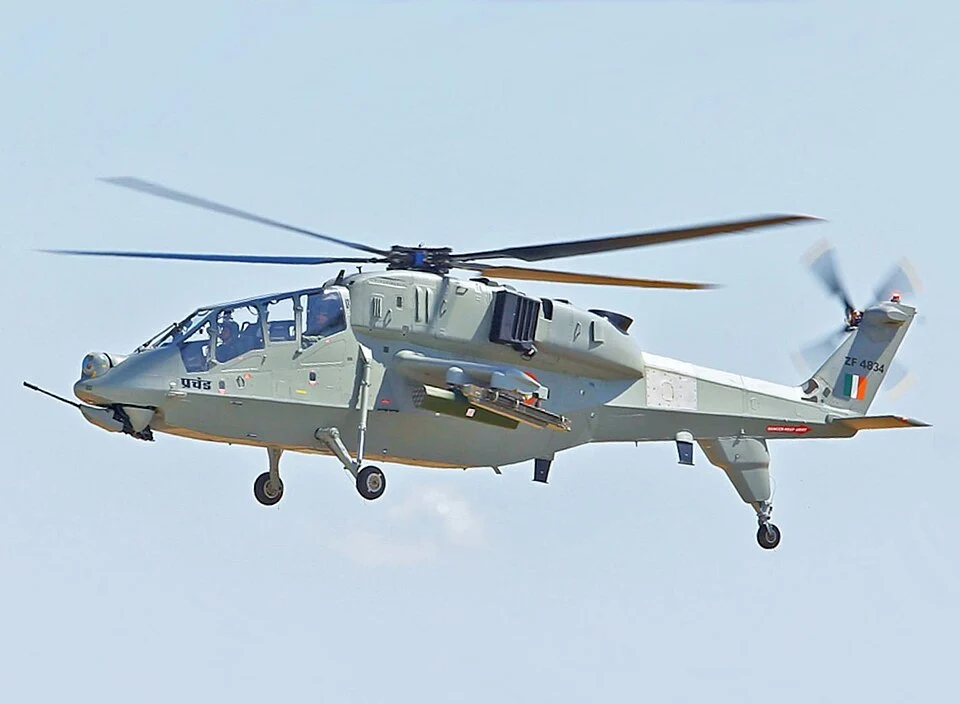
1. Introduction: The Birth of a High-Altitude Predator
The HAL Prachand (meaning “Fierce”) is not just another attack helicopter; it is a direct answer to the hard lessons of the 1999 Kargil War. During that conflict, India realized it lacked a rotorcraft that could fire weapons accurately at extreme altitudes. Developed by Hindustan Aeronautics Limited (HAL), this Light Combat Helicopter (LCH) was officially inducted into the Indian Air Force in October 2022.
2. Technical Specifications: The Shakti Behind the Machine
- Engine: Powered by twin HAL/Turbomeca Shakti-1H1 turboshaft engines, co-developed with France’s Safran.
- Performance:
- Range: Approximately 550 km to 700 km depending on payload.
- Top Speed: 268–280 km/h.
- Service Ceiling: An incredible 6,500 meters (approx. 21,300 feet), making it the only helicopter capable of landing and taking off at the Siachen Glacier.
- Operational Status: Currently, India has inducted an initial batch of 15 units, with a massive new order of 156 additional helicopters (90 for the Army, 66 for the IAF) cleared by the Ministry of Defence in March 2025 for ₹62,700 crore.
3. Lethal Arsenal: Weapons and Avionics
The HAL Prachand is a multi-role platform designed for “search and destroy” missions.
- Primary Gun: A nose-mounted 20mm M621 cannon on a Nexter THL-20 turret.
- Rockets & Missiles: Equipped with 70mm FZ275 laser-guided rockets and Mistral-2 air-to-air missiles.
- Anti-Tank: It is being integrated with the indigenous Dhruvastra (Helina) anti-tank guided missiles.
- Stealth Features: Its narrow fuselage and “stealth” profiling reduce its radar and infrared signatures, making it harder for enemy MANPADS to lock on.
4. Why India Needs Prachand: Countering China & Pakistan
Unlike the heavy American AH-64 Apache, which is a powerhouse in plains and deserts, the Prachand is specifically optimized for the “Thin Air” of the Himalayas. At the Line of Actual Control (LAC), where China has deployed its Z-10 helicopters, the Prachand provides India with a localized edge. It can provide close air support to troops at altitudes where most other helicopters struggle to even lift off with a full weapon load.
5. HAL Prachand vs. Opponents
| Feature | HAL Prachand (India) | AH-64 Apache (USA) | CAIC Z-10 (China) |
|---|---|---|---|
| Weight Class | 5.8 Tonnes (Light) | 10+ Tonnes (Heavy) | 7 Tonnes (Medium) |
| Max Altitude | ~21,000 ft (Superior) | ~20,000 ft | ~20,000 ft |
| Cost | ~$25M – $30M | ~$80M+ | ~$20M – $25M |
| Core Strength | High-Altitude Agility | Raw Firepower & Armor | Multi-role capability |
6. Why HAL Prachand is Better (In Its Role)
- Designed specifically for mountain warfare
- Lower cost, easier maintenance
- Indigenous upgrades possible
- Better agility due to lighter frame
7. Future Outlook: Exports and Upgrades
The future of the HAL Prachand looks global. Nations like Argentina, Nigeria, and the Philippines have expressed strong interest in the platform due to its cost-effectiveness (estimated at $20–$32 million per unit) and unique mountain warfare capabilities. Future variants will feature upgraded electronic warfare suites, indigenous radars, and even loitering munition (drone) integration.
see more about
7 Deadliest India Made Missiles You Should Know
India’s Fighter Jets in 2026: Rafale, Su-30MKI, Tejas