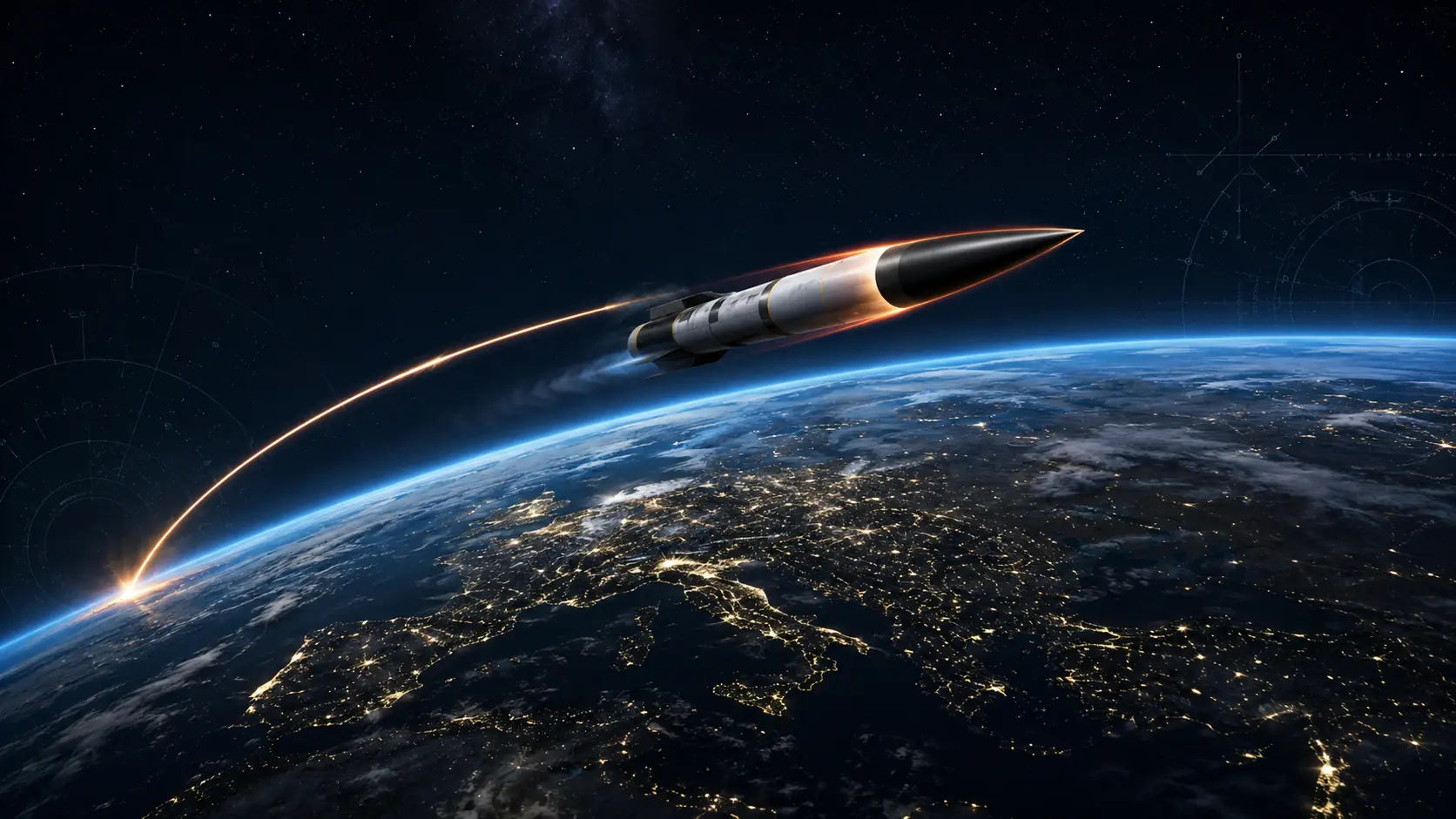
<p>A missile leaves its silo. Within minutes it is in space. Within 30 minutes it is back through the atmosphere on the other side of the planet. This is what global strike capability actually means — and it permanently changed how nations think, negotiate, and survive.</p>
<p><strong>Global strike capability</strong> — the ability to put a warhead anywhere on Earth in under 30 minutes — did not arrive quietly. It arrived with a Soviet R-7 rocket in 1957, and from that moment, the protection that oceans and distance gave civilisations for thousands of years simply ceased to exist. A capital on the other side of the planet became, in military terms, as close as the next town.</p>
<h3 class="wp-block-heading">1. What “Global Strike Capability” Actually Means</h3>
<p>Strip the jargon and the definition is simple: a state possesses global strike capability when it can credibly deliver a destructive payload to any location on Earth, from its own territory or platforms it controls, within a timeframe that forecloses meaningful defensive response.</p>
<p>It is fundamentally about reach and speed, not warhead yield. A nuclear warhead arriving in 28 minutes is strategically different from one arriving in 4 hours — decision-makers have almost no time to confirm the attack, verify it is not a false alarm, and authorise a response. That compression of time is the real weapon.</p>
<h3 class="wp-block-heading">2. “Covering the Entire Earth” Is Not What You Think</h3>
<p>A missile does not need to travel Earth’s full circumference. The farthest two surface points are about 20,000 km apart — an 18,000 km-range missile launched from the right position reaches anywhere. More important than single-missile range is how nations spread their platforms: silos across Siberia, road-mobile launchers in the interior, submarines in every ocean. Their collective reach is what makes the capability truly global.</p>
<p><strong>The Polar Route</strong><br>ICBMs arc into sub-orbital space rather than following Earth’s curve. A missile from Russia to the eastern United States travels over the Arctic — shorter, and historically it bypassed U.S. radar networks positioned to detect threats from the south. Earth’s rotation also means the target moves during the 25-minute flight, and guidance computers adjust continuously.</p>
<h3 class="wp-block-heading">3. The Three Phases of an ICBM Flight</h3>
<p><strong>1 Boost Phase</strong><br>This initial stage lasts between three and five minutes. Massive liquid or solid-fuel rocket engines ignite to push the payload out of Earth’s heavy atmospheric drag. The weapon experiences extreme thermal stress and must generate hundreds of thousands of pounds of thrust to break away from the lower atmosphere.</p>
<p><strong>2 Midcourse Phase</strong><br>Once the rocket boosters burn out and detach, the weapon enters the midcourse phase. This is the longest part of the journey, lasting roughly 15 to 20 minutes. During this period, the payload travels through the vacuum of space in a suborbital parabolic arc, reaching altitudes of up to 1,200 kilometers—higher than the International Space Station.</p>
<p><strong>3 Reentry Phase</strong><br>In the final three to five minutes, gravity pulls the warheads back into the atmosphere. The vehicles travel at hypersonic speeds, often exceeding Mach 20 (approximately 24,000 kilometers per hour). The air friction generates temperatures hot enough to turn air into plasma, requiring advanced carbon-composite heat shielding to prevent the payload from disintegrating before impact.</p>
<h3 class="wp-block-heading">4. What “Intercontinental” Did to the Meaning of Distance</h3>
<p>Before ICBMs, geography meant security. Two oceans shielded the United States. The English Channel shielded Britain. Distance was warning time, and warning time was survival. ICBMs erased that logic in a single step — and replaced it with Mutually Assured Destruction: the only way to prevent a nuclear strike is to guarantee that no first strike can ever prevent devastating retaliation. This logic made submarines the most important weapons in any nuclear arsenal. A submarine at sea cannot be targeted if nobody knows where it is.</p>
<h3 class="wp-block-heading">5. Which Nations Have True Global Strike Capability</h3>
<p>The intercontinental threshold is 5,500 km. Below it: regional danger. Above it: a fundamentally different category of strategic power. Here is where the major systems sit today.</p>
<figure class="wp-block-table"><table class="has-fixed-layout"><thead><tr><th>Missile</th><th>Country</th><th>Range</th><th>Speed</th><th>Role</th></tr></thead><tbody><tr><td>RS-28 Sarmat</td><td><strong>Russia</strong></td><td>~18,000 km</td><td>Mach 20+</td><td>World’s longest-range ICBM; FOBS-capable; can attack over the South Pole, bypassing northern radar networks</td></tr><tr><td>RS-24 Yars</td><td><strong>Russia</strong></td><td>~11,000 km</td><td>Mach 20</td><td>Core of Russia’s land-based nuclear force; road-mobile variant makes pre-launch targeting extremely difficult</td></tr><tr><td>LGM-30G Minuteman III</td><td><strong>USA</strong></td><td>~13,000 km</td><td>~Mach 23</td><td>400 deployed across three wings; land-based leg of U.S. nuclear triad; being replaced by LGM-35 Sentinel</td></tr><tr><td>Trident II D5</td><td><strong>USA / UK</strong></td><td>~12,000 km</td><td>Mach 24</td><td>Most accurate sea-based missile ever built; second-strike backbone; forms the entirety of the UK nuclear deterrent</td></tr><tr><td>DF-41</td><td><strong>China</strong></td><td>12,000–15,000 km</td><td>~Mach 25</td><td>China’s longest-range ICBM; MIRV-capable; road mobility makes pre-launch location nearly impossible to fix</td></tr><tr><td>M51 SLBM</td><td><strong>France</strong></td><td>~10,000 km</td><td>Mach 20+</td><td>France’s sole nuclear delivery system; entirely sea-based; underpins independent deterrence outside NATO command</td></tr><tr><td>Agni-V</td><td><strong>India</strong></td><td>5,000–8,000+ km</td><td>~Mach 24</td><td>India’s entry into intercontinental range; MIRV development underway; third Asian nuclear power in this bracket</td></tr><tr><td>Hwasong-17</td><td><strong>North Korea</strong></td><td>~13,000–15,000 km</td><td>Mach 20+</td><td>Largest road-mobile ICBM ever built; liquid-fueled; can theoretically reach the entire continental USA</td></tr></tbody></table></figure>
<p>Three things from this table worth noting: France has no land-based ICBMs — a deliberate choice to maximise second-strike survivability. The UK’s entire nuclear deterrent is Trident II D5 missiles it does not manufacture, leased from a shared pool with the United States. And India’s Agni-V makes it the third Asian state with intercontinental reach, in a region with no formal arms control architecture.</p>
<h3 class="wp-block-heading">6. The Parts Nobody Talks About</h3>
<h4 class="wp-block-heading">Submarines are the cornerstone, not the supplement</h4>
<p>A nuclear submarine at sea is, for all practical purposes, undetectable. It cannot be targeted in a first strike. This makes it the guarantor of second-strike capability — the reason an aggressor knows that even destroying every silo still leaves something waiting to respond. The submarine’s strategic value is its invisibility, not its firepower.</p>
<h4 class="wp-block-heading">Communication is harder than it sounds</h4>
<p>Launching a nuclear weapon requires a chain of communication from political leadership to launch crew that must survive even as the country is being destroyed. Extremely Low Frequency radio can reach submerged submarines but carries almost no data. The U.S. maintains airborne command posts — modified aircraft acting as flying nuclear command centres — because ground-based infrastructure is considered too vulnerable in a first strike.</p>
<h4 class="wp-block-heading">Early warning is the clock everything runs on</h4>
<p>Detection starts within seconds via infrared satellites tracking the boost-phase heat signature. From confirmed launch to warhead impact: under 30 minutes for a silo-based ICBM, under 10 minutes for a close-range submarine launch. That is the actual window for a decision authority to confirm, verify, and authorise a response. The <a href="https://missilethreat.csis.org/" target="_blank" rel="noreferrer noopener">CSIS Missile Threat Project</a> and the <a href="https://www.armscontrol.org/" target="_blank" rel="noreferrer noopener">Arms Control Association</a> maintain the most reliable open-source tracking of these systems.</p>
<h3 class="wp-block-heading">7. The Weapons Built Never to Be Fired</h3>
<p>Nuclear-armed states have never gone to war directly with each other — not once in eight decades. The threat of mutual annihilation has, so far, functioned as designed. But the architecture rests on assumptions that cannot be fully verified: that all parties behave rationally under extreme pressure, that systems work without malfunction, that no one mistakes a false alarm for a real launch.</p>
<p>In 1983, Soviet early-warning satellites registered what appeared to be a U.S. ICBM launch. One officer — Stanislav Petrov — concluded it was a sensor malfunction and did not report it up the chain. He was right. The world’s margin of safety, in that moment, was one man’s judgment call. The most dangerous element of global strike capability is not the yield or the range. It is the compression of decision time — the faster the weapon, the less room there is for human judgment before events become irreversible.</p>
<h3 class="wp-block-heading">Built to Deter, Not to Destroy</h3>
<p>These systems exist as a form of negative capability — their value is measured entirely in the conflicts they prevent. A missile never launched, a submarine never detected, a launch order never given: these are the operational successes of nuclear deterrence. It is the most expensive form of inaction in human history, and every nation that maintains it devoutly hopes it stays that way.</p>
<p></p>
<p>see more about<br><a href="https://nationnotifier.com/top-5-cruise-missiles-world-rankings-2025/" data-type="post" data-id="2236">Top 5 Most Powerful Cruise Missiles in the World (2025 Rankings)</a><br><a href="https://nationnotifier.com/7-deadliest-india-made-missiles-indigenous-defense/" data-type="post" data-id="4034">7 Deadliest India Made Missiles You Should Know</a></p>
A missile leaves its silo. Within minutes it is in space. Within 30 minutes it is back through the atmosphere on the other side of the planet. This is what global strike capability actually means — and it permanently changed how nations think, negotiate, and survive.
Global strike capability — the ability to put a warhead anywhere on Earth in under 30 minutes — did not arrive quietly. It arrived with a Soviet R-7 rocket in 1957, and from that moment, the protection that oceans and distance gave civilisations for thousands of years simply ceased to exist. A capital on the other side of the planet became, in military terms, as close as the next town.
1. What “Global Strike Capability” Actually Means
Strip the jargon and the definition is simple: a state possesses global strike capability when it can credibly deliver a destructive payload to any location on Earth, from its own territory or platforms it controls, within a timeframe that forecloses meaningful defensive response.
It is fundamentally about reach and speed, not warhead yield. A nuclear warhead arriving in 28 minutes is strategically different from one arriving in 4 hours — decision-makers have almost no time to confirm the attack, verify it is not a false alarm, and authorise a response. That compression of time is the real weapon.
2. “Covering the Entire Earth” Is Not What You Think
A missile does not need to travel Earth’s full circumference. The farthest two surface points are about 20,000 km apart — an 18,000 km-range missile launched from the right position reaches anywhere. More important than single-missile range is how nations spread their platforms: silos across Siberia, road-mobile launchers in the interior, submarines in every ocean. Their collective reach is what makes the capability truly global.
The Polar Route ICBMs arc into sub-orbital space rather than following Earth’s curve. A missile from Russia to the eastern United States travels over the Arctic — shorter, and historically it bypassed U.S. radar networks positioned to detect threats from the south. Earth’s rotation also means the target moves during the 25-minute flight, and guidance computers adjust continuously.
3. The Three Phases of an ICBM Flight
1 Boost Phase This initial stage lasts between three and five minutes. Massive liquid or solid-fuel rocket engines ignite to push the payload out of Earth’s heavy atmospheric drag. The weapon experiences extreme thermal stress and must generate hundreds of thousands of pounds of thrust to break away from the lower atmosphere.
2 Midcourse Phase Once the rocket boosters burn out and detach, the weapon enters the midcourse phase. This is the longest part of the journey, lasting roughly 15 to 20 minutes. During this period, the payload travels through the vacuum of space in a suborbital parabolic arc, reaching altitudes of up to 1,200 kilometers—higher than the International Space Station.
3 Reentry Phase In the final three to five minutes, gravity pulls the warheads back into the atmosphere. The vehicles travel at hypersonic speeds, often exceeding Mach 20 (approximately 24,000 kilometers per hour). The air friction generates temperatures hot enough to turn air into plasma, requiring advanced carbon-composite heat shielding to prevent the payload from disintegrating before impact.
4. What “Intercontinental” Did to the Meaning of Distance
Before ICBMs, geography meant security. Two oceans shielded the United States. The English Channel shielded Britain. Distance was warning time, and warning time was survival. ICBMs erased that logic in a single step — and replaced it with Mutually Assured Destruction: the only way to prevent a nuclear strike is to guarantee that no first strike can ever prevent devastating retaliation. This logic made submarines the most important weapons in any nuclear arsenal. A submarine at sea cannot be targeted if nobody knows where it is.
5. Which Nations Have True Global Strike Capability
The intercontinental threshold is 5,500 km. Below it: regional danger. Above it: a fundamentally different category of strategic power. Here is where the major systems sit today.
Missile
Country
Range
Speed
Role
RS-28 Sarmat
Russia
~18,000 km
Mach 20+
World’s longest-range ICBM; FOBS-capable; can attack over the South Pole, bypassing northern radar networks
RS-24 Yars
Russia
~11,000 km
Mach 20
Core of Russia’s land-based nuclear force; road-mobile variant makes pre-launch targeting extremely difficult
LGM-30G Minuteman III
USA
~13,000 km
~Mach 23
400 deployed across three wings; land-based leg of U.S. nuclear triad; being replaced by LGM-35 Sentinel
Trident II D5
USA / UK
~12,000 km
Mach 24
Most accurate sea-based missile ever built; second-strike backbone; forms the entirety of the UK nuclear deterrent
DF-41
China
12,000–15,000 km
~Mach 25
China’s longest-range ICBM; MIRV-capable; road mobility makes pre-launch location nearly impossible to fix
M51 SLBM
France
~10,000 km
Mach 20+
France’s sole nuclear delivery system; entirely sea-based; underpins independent deterrence outside NATO command
Agni-V
India
5,000–8,000+ km
~Mach 24
India’s entry into intercontinental range; MIRV development underway; third Asian nuclear power in this bracket
Hwasong-17
North Korea
~13,000–15,000 km
Mach 20+
Largest road-mobile ICBM ever built; liquid-fueled; can theoretically reach the entire continental USA
Three things from this table worth noting: France has no land-based ICBMs — a deliberate choice to maximise second-strike survivability. The UK’s entire nuclear deterrent is Trident II D5 missiles it does not manufacture, leased from a shared pool with the United States. And India’s Agni-V makes it the third Asian state with intercontinental reach, in a region with no formal arms control architecture.
6. The Parts Nobody Talks About
Submarines are the cornerstone, not the supplement
A nuclear submarine at sea is, for all practical purposes, undetectable. It cannot be targeted in a first strike. This makes it the guarantor of second-strike capability — the reason an aggressor knows that even destroying every silo still leaves something waiting to respond. The submarine’s strategic value is its invisibility, not its firepower.
Communication is harder than it sounds
Launching a nuclear weapon requires a chain of communication from political leadership to launch crew that must survive even as the country is being destroyed. Extremely Low Frequency radio can reach submerged submarines but carries almost no data. The U.S. maintains airborne command posts — modified aircraft acting as flying nuclear command centres — because ground-based infrastructure is considered too vulnerable in a first strike.
Early warning is the clock everything runs on
Detection starts within seconds via infrared satellites tracking the boost-phase heat signature. From confirmed launch to warhead impact: under 30 minutes for a silo-based ICBM, under 10 minutes for a close-range submarine launch. That is the actual window for a decision authority to confirm, verify, and authorise a response. The CSIS Missile Threat Project and the Arms Control Association maintain the most reliable open-source tracking of these systems.
7. The Weapons Built Never to Be Fired
Nuclear-armed states have never gone to war directly with each other — not once in eight decades. The threat of mutual annihilation has, so far, functioned as designed. But the architecture rests on assumptions that cannot be fully verified: that all parties behave rationally under extreme pressure, that systems work without malfunction, that no one mistakes a false alarm for a real launch.
In 1983, Soviet early-warning satellites registered what appeared to be a U.S. ICBM launch. One officer — Stanislav Petrov — concluded it was a sensor malfunction and did not report it up the chain. He was right. The world’s margin of safety, in that moment, was one man’s judgment call. The most dangerous element of global strike capability is not the yield or the range. It is the compression of decision time — the faster the weapon, the less room there is for human judgment before events become irreversible.
Built to Deter, Not to Destroy
These systems exist as a form of negative capability — their value is measured entirely in the conflicts they prevent. A missile never launched, a submarine never detected, a launch order never given: these are the operational successes of nuclear deterrence. It is the most expensive form of inaction in human history, and every nation that maintains it devoutly hopes it stays that way.